Ch. 2 - Limits
Briggs - Calculus: Early Transcendentals 3rd Edition
Briggs3rd EditionCalculus: Early TranscendentalsISBN: 9780136847243Non è quello che usi tu?Cambia libro di testo
Capitolo 2, Problema 63

Determine the interval(s) on which the following functions are continuous; then analyze the given limits. 


f(x)=1+sin x / cos x; limx→π/2^− f(x); lim x→4π/3 f(x)

Guida verificata passo dopo passo
1
The function given is \( f(x) = 1 + \frac{\sin x}{\cos x} \). This can be rewritten as \( f(x) = 1 + \tan x \) since \( \tan x = \frac{\sin x}{\cos x} \).
The function \( \tan x \) is continuous wherever \( \cos x \neq 0 \). The cosine function is zero at odd multiples of \( \frac{\pi}{2} \), i.e., \( x = \frac{\pi}{2} + k\pi \) where \( k \) is an integer.
Since \( f(x) = 1 + \tan x \), it is continuous on intervals where \( \tan x \) is continuous. Therefore, \( f(x) \) is continuous on intervals of the form \( (k\pi - \frac{\pi}{2}, k\pi + \frac{\pi}{2}) \) for integer \( k \).
As \( x \) approaches \( \pi/2 \) from the left, \( \tan x \to +\infty \) because \( \cos x \to 0^+ \). Therefore, \( f(x) = 1 + \tan x \to +\infty \).
At \( x = 4\pi/3 \), \( \cos(4\pi/3) \neq 0 \), so \( \tan(4\pi/3) \) is defined. Calculate \( \tan(4\pi/3) \) and substitute into \( f(x) = 1 + \tan x \) to find the limit.>

Risposta video verificata per un problema simile:

Questa soluzione video è stata consigliata dai nostri tutor come utile per risolvere questo problema.
Durata del video:
4m

Concetti chiave

Ecco i concetti essenziali che devi comprendere per rispondere correttamente alla domanda.

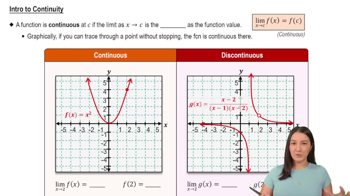
Continuity of Functions

A function is continuous at a point if the limit of the function as it approaches that point equals the function's value at that point. For a function to be continuous over an interval, it must be continuous at every point within that interval. Understanding continuity is essential for analyzing the behavior of functions, especially when determining where they are defined and how they behave near critical points.
Video consigliato:
05:34
Intro to Continuity

Limits

A limit describes the value that a function approaches as the input approaches a certain point. Limits are fundamental in calculus, particularly for understanding the behavior of functions at points where they may not be explicitly defined, such as points of discontinuity. Evaluating limits helps in analyzing the continuity and differentiability of functions, which is crucial for solving problems involving calculus.
Video consigliato:
05:50
One-Sided Limits

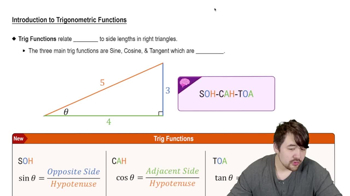
Trigonometric Functions

Trigonometric functions, such as sine and cosine, are periodic functions that relate angles to ratios of sides in right triangles. They play a significant role in calculus, especially in determining the behavior of functions involving angles. Understanding the properties of these functions, including their continuity and limits, is vital for analyzing expressions like f(x) = (1 + sin x) / cos x, particularly at points where the denominator may approach zero.
Video consigliato:
Percorso guidato
6:04
Introduction to Trigonometric Functions