Ch. 2 - Limits
Briggs - Calculus: Early Transcendentals 3rd Edition
Briggs3rd EditionCalculus: Early TranscendentalsISBN: 9780136847243Non è quello che usi tu?Cambia libro di testo
Capitolo 2, Problema 44

Determine the interval(s) on which the following functions are continuous. At which finite endpoints of the intervals of continuity is f continuous from the left or continuous from the right? 


f(x)=√x^2−3x+2

Guida verificata passo dopo passo
1
The function \( f(x) = \sqrt{x^2 - 3x + 2} \) is defined where the expression under the square root is non-negative. Therefore, solve the inequality \( x^2 - 3x + 2 \geq 0 \).
Factor \( x^2 - 3x + 2 \) as \( (x-1)(x-2) \).
Use a sign chart or test points to determine where \( (x-1)(x-2) \geq 0 \). The critical points are \( x = 1 \) and \( x = 2 \).
The intervals to test are \( (-\infty, 1) \), \( (1, 2) \), and \( (2, \infty) \). Determine the sign of the product in each interval.
Check the behavior of \( f(x) \) as \( x \) approaches the endpoints \( x = 1 \) and \( x = 2 \) from the left and right to determine if \( f \) is continuous from the left or right at these points.

Risposta video verificata per un problema simile:

Questa soluzione video è stata consigliata dai nostri tutor come utile per risolvere questo problema.
Durata del video:
6m

Concetti chiave

Ecco i concetti essenziali che devi comprendere per rispondere correttamente alla domanda.

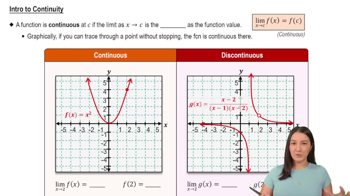
Continuity of Functions

A function is continuous at a point if the limit of the function as it approaches that point equals the function's value at that point. For a function to be continuous over an interval, it must be continuous at every point within that interval. This concept is crucial for determining where a function does not have breaks, jumps, or asymptotes.
Video consigliato:
05:34
Intro to Continuity

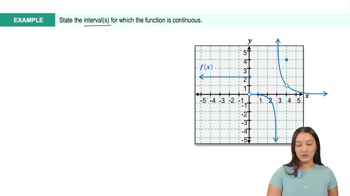
Finding Intervals of Continuity

To find the intervals of continuity for a function, one must identify points where the function is undefined or where it has discontinuities. This often involves analyzing the function's domain and any points where the function's behavior changes, such as roots or vertical asymptotes. For the given function, this requires solving the equation under the square root to find valid x-values.
Video consigliato:
03:38
Intro to Continuity Example 1

One-Sided Limits

One-sided limits are used to determine the behavior of a function as it approaches a specific point from either the left or the right. A function is continuous from the left at a point if the left-hand limit equals the function's value at that point, and similarly for continuity from the right. This concept is essential for analyzing endpoints of intervals of continuity, especially when the function may behave differently as it approaches these points.
Video consigliato:
05:50
One-Sided Limits