Ch. 2 - Limits
Briggs - Calculus: Early Transcendentals 3rd Edition
Briggs3rd EditionCalculus: Early TranscendentalsISBN: 9780136847243Non è quello che usi tu?Cambia libro di testo
Capitolo 2, Problema 71a

Determine whether the following statements are true and give an explanation or counterexample. Assume a and L are finite numbers.
If limx→a f(x) = L, then f(a)=L.

Guida verificata passo dopo passo
1
Step 1: Understand the statement. The statement claims that if the limit of a function \( f(x) \) as \( x \) approaches \( a \) is \( L \), then the function value at \( a \), \( f(a) \), must also be \( L \).
Step 2: Recall the definition of a limit. The limit \( \lim_{x \to a} f(x) = L \) means that as \( x \) gets arbitrarily close to \( a \), \( f(x) \) gets arbitrarily close to \( L \).
Step 3: Consider the concept of continuity. A function \( f(x) \) is continuous at \( x = a \) if \( \lim_{x \to a} f(x) = f(a) \).
Step 4: Identify a counterexample. Consider the function \( f(x) = \frac{\sin(x)}{x} \) for \( x \neq 0 \) and \( f(0) = 1 \). The limit \( \lim_{x \to 0} \frac{\sin(x)}{x} = 1 \), but \( f(0) = 1 \).
Step 5: Conclude the analysis. The statement is not necessarily true because a function can have a limit at a point without being continuous at that point, meaning \( f(a) \) does not have to equal \( L \).

Risposta video verificata per un problema simile:

Questa soluzione video è stata consigliata dai nostri tutor come utile per risolvere questo problema.
Durata del video:
3m

Concetti chiave

Ecco i concetti essenziali che devi comprendere per rispondere correttamente alla domanda.

Limit of a Function

The limit of a function describes the behavior of the function as the input approaches a certain value. Specifically, limx→a f(x) = L means that as x gets arbitrarily close to a, the values of f(x) approach L. This concept is fundamental in calculus as it helps in understanding continuity and the behavior of functions near specific points.
Video consigliato:
06:11
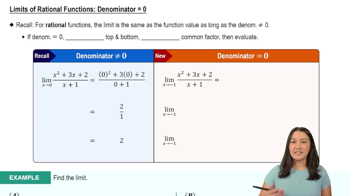
Limits of Rational Functions: Denominator = 0

Continuity

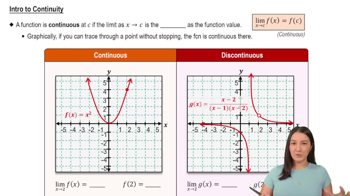
A function is continuous at a point a if the limit of the function as x approaches a equals the function's value at that point, i.e., limx→a f(x) = f(a). This means there are no breaks, jumps, or holes in the graph of the function at that point. Understanding continuity is crucial for evaluating the truth of the statement regarding limits and function values.
Video consigliato:
05:34
Intro to Continuity

Counterexample

A counterexample is a specific case that disproves a general statement. In the context of limits, if we find a function where limx→a f(x) = L but f(a) ≠ L, it serves as a counterexample to the claim that the limit implies the function's value at that point. This concept is essential for critical thinking and validating mathematical statements.