Ch. 2 - Limits
Briggs - Calculus: Early Transcendentals 3rd Edition
Briggs3rd EditionCalculus: Early TranscendentalsISBN: 9780136847243Non è quello che usi tu?Cambia libro di testo
Capitolo 2, Problema 2.41

Estimate the following limits using graphs or tables.
limh→0ln(1+h)h{\(\displaystyle\)\(\lim\)_{h\(\to\)0}}\(\frac{\ln\left(1+h\right)}{h}\)

Guida verificata passo dopo passo
1
Recognize that the limit \( \lim_{h \to 0} \frac{\ln(1+h)}{h} \) is a standard limit that can be evaluated using the definition of the derivative.
Identify that the expression \( \frac{\ln(1+h)}{h} \) resembles the difference quotient for the derivative of \( \ln(x) \) at \( x = 1 \).
Recall that the derivative of \( \ln(x) \) is \( \frac{1}{x} \). Therefore, at \( x = 1 \), the derivative is \( \frac{1}{1} = 1 \).
Conclude that the limit \( \lim_{h \to 0} \frac{\ln(1+h)}{h} \) is equal to the derivative of \( \ln(x) \) at \( x = 1 \), which is 1.
Alternatively, use L'Hôpital's Rule, which applies to limits of the form \( \frac{0}{0} \), by differentiating the numerator and the denominator separately and then taking the limit.

Risposta video verificata per un problema simile:

Questa soluzione video è stata consigliata dai nostri tutor come utile per risolvere questo problema.
Durata del video:
4m

Concetti chiave

Ecco i concetti essenziali che devi comprendere per rispondere correttamente alla domanda.

Limits

Limits are fundamental in calculus, representing the value that a function approaches as the input approaches a certain point. In this context, we are interested in the limit of the function ln(1+h)/h as h approaches 0. Understanding limits is crucial for analyzing the behavior of functions near specific points, especially when direct substitution may lead to indeterminate forms.
Video consigliato:
05:50
One-Sided Limits

Natural Logarithm

The natural logarithm, denoted as ln(x), is the logarithm to the base e, where e is approximately 2.71828. It is a key function in calculus, particularly in relation to growth rates and areas under curves. In the limit expression given, ln(1+h) captures the behavior of logarithmic growth as h approaches 0, which is essential for evaluating the limit.
Video consigliato:
05:18
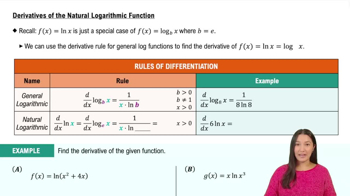
Derivative of the Natural Logarithmic Function

L'Hôpital's Rule

L'Hôpital's Rule is a method for evaluating limits of indeterminate forms, such as 0/0 or ∞/∞. It states that if the limit of f(x)/g(x) results in an indeterminate form, the limit can be found by taking the derivative of the numerator and the derivative of the denominator. This rule can be applied to the limit in the question, allowing for a more straightforward evaluation of the limit as h approaches 0.
Video consigliato:
5:50
Power Rules
Pratica correlata
Domanda del libro di testo

Sketch a graph of f and use it to make a conjecture about the values of f(a), lim x→a^−f(x),lim x→a^+f(x), and lim x→a f(x) or state that they do not exist.

f(x) = {√x if x<4

3 if x=4; a=4

x+1 if x>4

337
views

Domanda del libro di testo

Determine limx→∞f(x)\(\lim\)_{x\(\rightarrow\)\(\infty\)}f\(\left\)(x\(\right\)) and limx→−∞f(x)\(\lim\)_{x\(\rightarrow\)-\(\infty\)}f\(\left\)(x\(\right\)) for the following functions. Then give the horizontal asymptotes of ff (if any).


f(x)=4x(3x−9x2+1)f\(\left\)(x\(\right\))=4x\(\left\)(3x-\(\sqrt{9x^2+1}\)\(\right\))

348
views
Domanda del libro di testo

Determine limx→∞f(x)\(\lim\)_{x\(\rightarrow\)\(\infty\)}f\(\left\)(x\(\right\)) and limx→−∞f(x)\(\lim\)_{x\(\rightarrow\)-\(\infty\)}f\(\left\)(x\(\right\)) for the following functions. Then give the horizontal asymptotes of ff (if any).


f(x)=6x2−9x+83x2+2f\(\left\)(x\(\right\))=\(\frac{6x^2-9x+8}{3x^2+2}\)

391
views
Domanda del libro di testo

Consider the position function s(t) =−16t^2+100t representing the position of an object moving vertically along a line. Sketch a graph of s with the secant line passing through (0.5, s(0.5)) and (2, s(2)). Determine the slope of the secant line and explain its relationship to the moving object.

370
views
Domanda del libro di testo

Sketch a graph of f and use it to make a conjecture about the values of f(a), lim x→a^−f(x),lim x→a^+f(x), and lim x→a f(x) or state that they do not exist.

f(x) = x^2+x−2 / x−1; a=1

386
views
Domanda del libro di testo

Use an appropriate limit definition to prove the following limits.


lim x→ 5x^2 − 25 / x − 5=10

386
views