Ch. 2 - Limits
Briggs - Calculus: Early Transcendentals 3rd Edition
Briggs3rd EditionCalculus: Early TranscendentalsISBN: 9780136847243Non è quello che usi tu?Cambia libro di testo
Capitolo 2, Problema 50

Evaluate each limit. 
lim x→−1 (x^2−4+ 3√x^2−9)

Guida verificata passo dopo passo
1
Step 1: Identify the form of the limit as x approaches -1. Substitute x = -1 into the expression x^2 - 4 + 3\(\sqrt{x^2 - 9}\) to check if it results in an indeterminate form.
Step 2: Simplify the expression. Notice that x^2 - 4 is a polynomial and 3\(\sqrt{x^2 - 9}\) is a radical expression. Simplify each part separately.
Step 3: Substitute x = -1 into the simplified expression. Calculate x^2 - 4 and 3\(\sqrt{x^2 - 9}\) separately to see if the limit can be directly evaluated.
Step 4: If direct substitution results in an indeterminate form, consider using algebraic manipulation or L'Hôpital's Rule if applicable. Check if the expression can be factored or simplified further.
Step 5: Evaluate the limit using the simplified expression or the result from L'Hôpital's Rule. Ensure that the final expression is not indeterminate and provides a clear value for the limit.

Risposta video verificata per un problema simile:

Questa soluzione video è stata consigliata dai nostri tutor come utile per risolvere questo problema.
Durata del video:
1m

Concetti chiave

Ecco i concetti essenziali che devi comprendere per rispondere correttamente alla domanda.

Limits

A limit is a fundamental concept in calculus that describes the behavior of a function as its input approaches a certain value. It helps in understanding how functions behave near points of interest, including points of discontinuity or infinity. Evaluating limits often involves substituting values directly into the function, but sometimes requires algebraic manipulation or special techniques when direct substitution leads to indeterminate forms.
Video consigliato:
05:50
One-Sided Limits

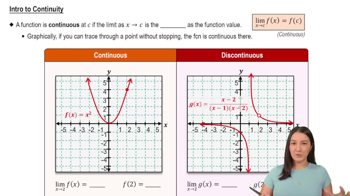
Continuous Functions

A function is continuous at a point if the limit of the function as it approaches that point equals the function's value at that point. This concept is crucial when evaluating limits, as continuous functions allow for straightforward substitution. If a function is not continuous at a point, special techniques such as factoring or using L'Hôpital's rule may be necessary to evaluate the limit.
Video consigliato:
05:34
Intro to Continuity

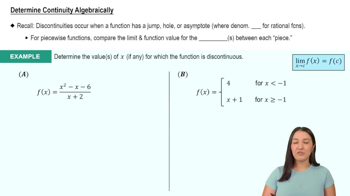
Algebraic Manipulation

Algebraic manipulation involves rearranging and simplifying expressions to facilitate limit evaluation. This can include factoring polynomials, rationalizing expressions, or combining like terms. In the context of limits, these techniques help resolve indeterminate forms, making it possible to find the limit by transforming the expression into a more manageable form.
Video consigliato:
05:25
Determine Continuity Algebraically