Ch. 2 - Limits
Briggs - Calculus: Early Transcendentals 3rd Edition
Briggs3rd EditionCalculus: Early TranscendentalsISBN: 9780136847243Non è quello che usi tu?Cambia libro di testo
Capitolo 2, Problema 35

Find the following limits or state that they do not exist. Assume a, b , c, and k are fixed real numbers.


lim x→4 x^2 − 16 / 4 − x

Guida verificata passo dopo passo
1
The expression \( \frac{x^2 - 16}{4 - x} \) is in an indeterminate form \( \frac{0}{0} \) as \( x \to 4 \).
Notice that \( x^2 - 16 \) is a difference of squares, which can be factored as \( (x - 4)(x + 4) \).
Substitute the factored form into the expression: \( \frac{(x - 4)(x + 4)}{4 - x} \).
Notice that \( 4 - x = -(x - 4) \), so the expression becomes \( \frac{(x - 4)(x + 4)}{-(x - 4)} \). Cancel \( x - 4 \) from the numerator and denominator, leaving \( -(x + 4) \).
Now that the expression is simplified to \( -(x + 4) \), substitute \( x = 4 \) to find the limit.>

Risposta video verificata per un problema simile:

Questa soluzione video è stata consigliata dai nostri tutor come utile per risolvere questo problema.
Durata del video:
2m

Concetti chiave

Ecco i concetti essenziali che devi comprendere per rispondere correttamente alla domanda.

Limits

A limit is a fundamental concept in calculus that describes the behavior of a function as its input approaches a certain value. It helps in understanding how functions behave near specific points, which is crucial for evaluating expressions that may be undefined at those points. In this case, we are interested in the limit as x approaches 4.
Video consigliato:
05:50
One-Sided Limits

Factoring

Factoring is the process of breaking down an expression into simpler components, which can help simplify complex limits. In the given limit, the expression x^2 - 16 can be factored into (x - 4)(x + 4), allowing for cancellation of terms that may lead to an indeterminate form when directly substituting x = 4.
Video consigliato:
06:11
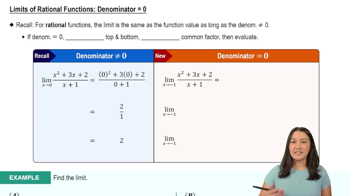
Limits of Rational Functions: Denominator = 0

Indeterminate Forms

Indeterminate forms occur when direct substitution in a limit leads to expressions like 0/0 or ∞/∞, which do not provide clear information about the limit's value. Recognizing these forms is essential, as they often require further manipulation, such as factoring or applying L'Hôpital's Rule, to evaluate the limit correctly.
Video consigliato:
3:56
Slope-Intercept Form