Ch. 2 - Limits
Briggs - Calculus: Early Transcendentals 3rd Edition
Briggs3rd EditionCalculus: Early TranscendentalsISBN: 9780136847243Non è quello che usi tu?Cambia libro di testo
Capitolo 2, Problema 95

Find the horizontal asymptotes of each function using limits at infinity.
f(x) = (2ex + 3) / (ex + 1)

Guida verificata passo dopo passo
1
Identify the dominant terms in the numerator and the denominator as x approaches infinity. In this case, both the numerator and the denominator have the dominant term e^x.
Divide every term in the numerator and the denominator by the dominant term e^x to simplify the expression.
The expression becomes (2 + 3/e^x) / (1 + 1/e^x).
Evaluate the limit of the simplified expression as x approaches infinity. As x approaches infinity, the terms 3/e^x and 1/e^x approach 0.
The limit of the expression as x approaches infinity is 2/1, which suggests that the horizontal asymptote is y = 2.

Risposta video verificata per un problema simile:

Questa soluzione video è stata consigliata dai nostri tutor come utile per risolvere questo problema.
Durata del video:
3m

Concetti chiave

Ecco i concetti essenziali che devi comprendere per rispondere correttamente alla domanda.

Horizontal Asymptotes

Horizontal asymptotes describe the behavior of a function as the input approaches infinity or negative infinity. They indicate the value that the function approaches but does not necessarily reach. To find horizontal asymptotes, we analyze the limits of the function as x approaches infinity or negative infinity.
Video consigliato:
5:46
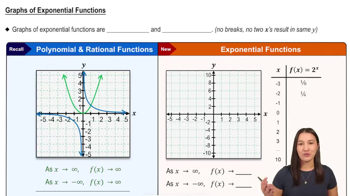
Graphs of Exponential Functions

Limits at Infinity

Limits at infinity involve evaluating the behavior of a function as the variable approaches infinity or negative infinity. This concept is crucial for determining horizontal asymptotes, as it helps identify the value that the function stabilizes at for large magnitudes of x. Techniques such as dividing by the highest power of x in the denominator are often used in this analysis.
Video consigliato:
05:50
One-Sided Limits

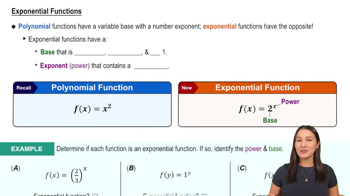
Exponential Functions

Exponential functions, such as e^x, grow rapidly as x increases. Understanding their growth rates is essential when analyzing limits at infinity, especially in rational functions where exponential terms can dominate. In the given function, recognizing how e^x behaves compared to constant terms is key to determining the horizontal asymptote.
Video consigliato:
6:13
Exponential Functions
Pratica correlata
Domanda del libro di testo

Even function limits Suppose f is an even function where lim x→1^− f(x)=5 and lim x→1^+ f(x)=6. Find lim x→−1^− f(x) and limx→−1^+ f(x).

374
views

Domanda del libro di testo

Let g(x)= {1 if x≥0

−1 if x<0.


a. Write a formula for |g(x)|.

366
views
Domanda del libro di testo

Suppose you park your car at a trailhead in a national park and begin a 2-hr hike to a lake at 7 A.M. on a Friday morning. On Sunday morning, you leave the lake at 7 A.M. and start the 2-hr hike back to your car. Assume the lake is 3 mi from your car. Let f(t) be your distance from the car t hours after 7 a.m. on Friday morning, and let g(t) be your distance from the car t hours after 7 a.m. on Sunday morning.


b. Let h(t)=f(t)−g(t). Find h(0) and h(2).

218
views
Domanda del libro di testo

Sketch a graph of y=2^x and carefully draw three secant lines connecting the points P(0, 1) and Q(x,2^x), for x=−3,−2, and −1.

430
views
Domanda del libro di testo

Suppose you park your car at a trailhead in a national park and begin a 2-hr hike to a lake at 7 A.M. on a Friday morning. On Sunday morning, you leave the lake at 7 A.M. and start the 2-hr hike back to your car. Assume the lake is 3 mi from your car. Let f(t) be your distance from the car t hours after 7 a.m. on Friday morning, and let g(t) be your distance from the car t hours after 7 a.m. on Sunday morning.


a. Evaluate f(0), f(2), g(0), and g(2).

324
views
Domanda del libro di testo

Find the horizontal asymptotes of each function using limits at infinity.

f(x) = (3e5x + 7e6x) / (9e5x + 14e6x)

386
views