
Ch. 2 - Limits
Briggs - Calculus: Early Transcendentals 3rd Edition
Briggs3rd EditionCalculus: Early TranscendentalsISBN: 9780136847243Non è quello che usi tu?Cambia libro di testo
Capitolo 2, Problema 2.R.78

Find the intervals on which the following functions are continuous. Specify right- or left-continuity at the finite endpoints.
g(x)=cos(ex)g\(\left\)(x\(\right\))=\(\cos\)\(\left\)(e^{x}\(\right\))

Guida verificata passo dopo passo
1
Step 1: Identify the components of the function g(x) = cos(e^x). The function is composed of an exponential function e^x and a trigonometric function cos(x).
Step 2: Determine the continuity of the inner function e^x. The exponential function e^x is continuous for all real numbers x.
Step 3: Determine the continuity of the outer function cos(x). The cosine function is continuous for all real numbers.
Step 4: Use the composition of continuous functions theorem. Since both e^x and cos(x) are continuous for all real numbers, their composition g(x) = cos(e^x) is also continuous for all real numbers.
Step 5: Conclude that g(x) = cos(e^x) is continuous on the interval (-∞, ∞). There are no finite endpoints to consider for right- or left-continuity.

Risposta video verificata per un problema simile:

Questa soluzione video è stata consigliata dai nostri tutor come utile per risolvere questo problema.
Durata del video:
2m

Concetti chiave

Ecco i concetti essenziali che devi comprendere per rispondere correttamente alla domanda.

Continuity of Functions

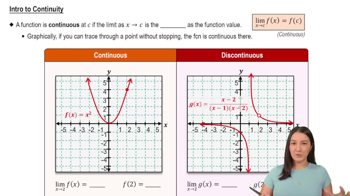
A function is continuous at a point if the limit of the function as it approaches that point equals the function's value at that point. For a function to be continuous over an interval, it must be continuous at every point within that interval. This concept is crucial for determining where a function does not have breaks, jumps, or asymptotes.
Video consigliato:
05:34
Intro to Continuity

Endpoints and Continuity

When analyzing the continuity of functions on closed intervals, special attention must be given to the endpoints. A function can be left-continuous at the left endpoint and right-continuous at the right endpoint. Understanding how a function behaves at these endpoints is essential for accurately describing its continuity over the entire interval.
Video consigliato:
05:34
Intro to Continuity

Behavior of Composite Functions

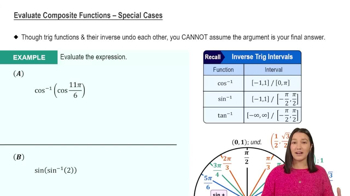
The function g(x) = cos(e^x) is a composite function, where the continuity of g depends on the continuity of both the cosine function and the exponential function. Since both functions are continuous everywhere, g(x) is also continuous for all real numbers. Recognizing how the continuity of inner and outer functions affects the overall function is vital in calculus.
Video consigliato:
3:48
Evaluate Composite Functions - Special Cases