Ch. 2 - Limits
Briggs - Calculus: Early Transcendentals 3rd Edition
Briggs3rd EditionCalculus: Early TranscendentalsISBN: 9780136847243Non è quello che usi tu?Cambia libro di testo
Capitolo 2, Problema 2.6.87b

Let g(x)={x2+xif x<1aif x=13x+5if x>1g\(\left\)(x\(\right\))=\(\begin{cases}\)x^2+x & \(\text{if }\)x<1\\ a & \(\text{if }\)x=1\\ 3x+5 & \(\text{if }\)x>1\(\end{cases}\)
b. Determine the value of aa for which gg is continuous from the right at 11. 

Guida verificata passo dopo passo
1
To determine the value of 'a' for which the function g(x) is continuous from the right at x = 1, we need to ensure that the right-hand limit of g(x) as x approaches 1 is equal to g(1).
The right-hand limit of g(x) as x approaches 1 is found by considering the expression for g(x) when x > 1, which is 3x + 5.
Calculate the right-hand limit: \( \lim_{{x \to 1^+}} g(x) = \lim_{{x \to 1^+}} (3x + 5) \).
Evaluate this limit by substituting x = 1 into the expression 3x + 5, which gives 3(1) + 5.
For g(x) to be continuous from the right at x = 1, set the right-hand limit equal to g(1), which is 'a'. Therefore, solve the equation 3(1) + 5 = a to find the value of 'a'.

Risposta video verificata per un problema simile:

Questa soluzione video è stata consigliata dai nostri tutor come utile per risolvere questo problema.
Durata del video:
2m

Concetti chiave

Ecco i concetti essenziali che devi comprendere per rispondere correttamente alla domanda.

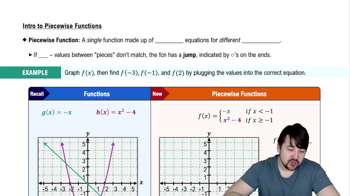
Piecewise Functions

A piecewise function is defined by different expressions based on the input value. In this case, the function g(x) has three distinct cases depending on whether x is less than, equal to, or greater than 1. Understanding how to evaluate piecewise functions is crucial for determining their properties, such as continuity.
Video consigliato:
Percorso guidato
05:36
Piecewise Functions

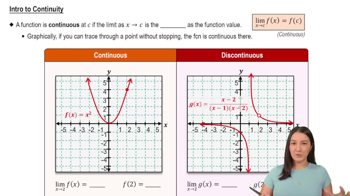
Continuity

A function is continuous at a point if the limit of the function as it approaches that point from both sides equals the function's value at that point. For g(x) to be continuous at x=1, the limit as x approaches 1 from the left must equal the limit as x approaches 1 from the right, and both must equal g(1). This concept is essential for solving the problem.
Video consigliato:
05:34
Intro to Continuity

Limits

Limits describe the behavior of a function as the input approaches a certain value. In this context, we need to find the left-hand limit (as x approaches 1 from values less than 1) and the right-hand limit (as x approaches 1 from values greater than 1) of g(x). Evaluating these limits will help determine the appropriate value of a that ensures continuity at x=1.
Video consigliato:
05:50
One-Sided Limits