Ch. 2 - Limits
Briggs - Calculus: Early Transcendentals 3rd Edition
Briggs3rd EditionCalculus: Early TranscendentalsISBN: 9780136847243Non è quello che usi tu?Cambia libro di testo
Capitolo 2, Problema 2.7.19

Use the precise definition of a limit to prove the following limits. Specify a relationship between ε and δ that guarantees the limit exists.
lim x→1 (8x+5)=13

Guida verificata passo dopo passo
1
Step 1: Recall the precise definition of a limit. The limit of a function f(x) as x approaches a value c is L if for every ε > 0, there exists a δ > 0 such that if 0 < |x - c| < δ, then |f(x) - L| < ε.
Step 2: Identify the function f(x) and the values of c and L from the given limit. Here, f(x) = 8x + 5, c = 1, and L = 13.
Step 3: Set up the inequality |f(x) - L| < ε using the function and limit value. This becomes |(8x + 5) - 13| < ε, which simplifies to |8x - 8| < ε.
Step 4: Simplify the inequality |8x - 8| < ε to find a relationship between x and ε. This simplifies to 8|x - 1| < ε, which further simplifies to |x - 1| < ε/8.
Step 5: Establish the relationship between ε and δ. From the inequality |x - 1| < ε/8, we can choose δ = ε/8. Therefore, for every ε > 0, if 0 < |x - 1| < δ, then |f(x) - 13| < ε, proving the limit.

Risposta video verificata per un problema simile:

Questa soluzione video è stata consigliata dai nostri tutor come utile per risolvere questo problema.
Durata del video:
2m

Concetti chiave

Ecco i concetti essenziali che devi comprendere per rispondere correttamente alla domanda.

Limit Definition

The precise definition of a limit states that for a function f(x) to approach a limit L as x approaches a value a, for every ε > 0, there exists a δ > 0 such that if 0 < |x - a| < δ, then |f(x) - L| < ε. This formalizes the intuitive idea of limits and is essential for proving limit statements rigorously.
Video consigliato:
Percorso guidato
05:43
Definition of the Definite Integral

Epsilon-Delta Relationship

In the context of limits, the ε (epsilon) represents how close f(x) must be to the limit L, while δ (delta) represents how close x must be to the point a. Establishing a relationship between ε and δ is crucial for proving that the limit exists, as it ensures that for any desired closeness to the limit, we can find a corresponding closeness to the point of interest.
Video consigliato:
Percorso guidato
05:53
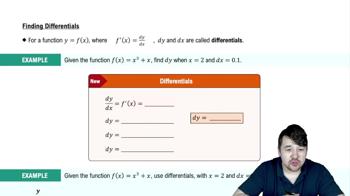
Finding Differentials

Function Evaluation

To prove the limit lim x→1 (8x + 5) = 13, we first evaluate the function at x = 1, yielding f(1) = 8(1) + 5 = 13. This evaluation is a critical step in the limit proof, as it confirms that the function approaches the expected limit value as x approaches 1, thereby supporting the overall limit statement.
Video consigliato:
Percorso guidato
4:26
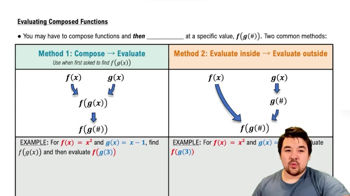
Evaluating Composed Functions