Ch. 2 - Limits
Briggs - Calculus: Early Transcendentals 3rd Edition
Briggs3rd EditionCalculus: Early TranscendentalsISBN: 9780136847243Non è quello che usi tu?Cambia libro di testo
Capitolo 2, Problema 1c

Which of the following functions are continuous for all values in their domain? Justify your answers.


c. T(t)=temperature t minutes after midnight in Chicago on January 1

Guida verificata passo dopo passo
1
Identify the type of function: T(t) represents a real-world scenario, specifically the temperature as a function of time.
Consider the nature of temperature changes: Temperature is typically a continuous function over time, as it changes gradually rather than abruptly.
Discuss potential discontinuities: In real-world scenarios, discontinuities might occur due to sudden events, but these are rare and not typical for temperature changes.
Conclude about continuity: Since temperature changes are generally smooth and gradual, T(t) is likely continuous for all values in its domain.
Justify with real-world context: In the absence of sudden, extreme events, temperature as a function of time is expected to be continuous.

Risposta video verificata per un problema simile:

Questa soluzione video è stata consigliata dai nostri tutor come utile per risolvere questo problema.
Durata del video:
1m

Concetti chiave

Ecco i concetti essenziali che devi comprendere per rispondere correttamente alla domanda.

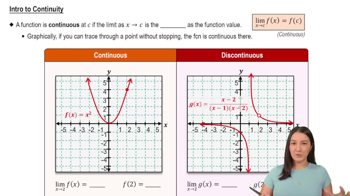
Continuity of Functions

A function is continuous at a point if the limit of the function as it approaches that point equals the function's value at that point. For a function to be continuous over its entire domain, it must be continuous at every point in that domain. This means there are no breaks, jumps, or asymptotes in the function's graph.
Video consigliato:
05:34
Intro to Continuity

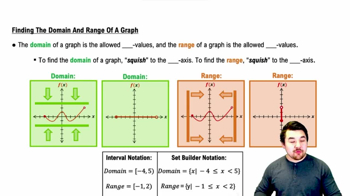
Domain of a Function

The domain of a function is the set of all possible input values (or 't' values) for which the function is defined. Understanding the domain is crucial for determining continuity, as a function may be continuous on its domain but not defined outside of it. For example, a temperature function may only be defined for certain time intervals.
Video consigliato:
Percorso guidato
5:10
Finding the Domain and Range of a Graph

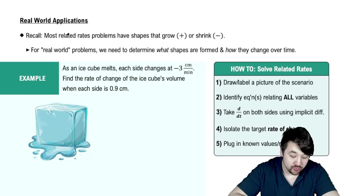
Real-World Context of Functions

In applied mathematics, functions often represent real-world phenomena, such as temperature over time. Analyzing these functions requires understanding how they behave in practical scenarios. For instance, temperature changes throughout the day can be modeled as a continuous function, but external factors may introduce discontinuities that need to be considered.
Video consigliato:
Percorso guidato
06:16
Real World Application