Ch. 3 - Derivatives
Briggs - Calculus: Early Transcendentals 3rd Edition
Briggs3rd EditionCalculus: Early TranscendentalsISBN: 9780136847243Non è quello che usi tu?Cambia libro di testo
Capitolo 3, Problema 3.7.112b

109-112 {Use of Tech} Calculating limits The following limits are the derivatives of a composite function g at a point a.
b. Use the Chain Rule to find each limit. Verify your answer by using a calculator.
limh→013((1+h)5+7)10−13(8)10h{\(\displaystyle\)\(\lim\)_{h\(\to\)0}}\(\frac{\frac{1}{3\left(\left(1+h\right)^5+7\right)^{10}\)}-\(\frac{1}{3\left(8\right)^{10}\)}}{h}

Guida verificata passo dopo passo
1
Step 1: Recognize that the given limit represents the derivative of a composite function g at a point a. The expression inside the limit is of the form \( \frac{f(x+h) - f(x)}{h} \), which is the definition of the derivative.
Step 2: Identify the inner function and the outer function. Here, the inner function is \( u(h) = (1+h)^5 + 7 \) and the outer function is \( v(u) = \frac{1}{3u^{10}} \).
Step 3: Apply the Chain Rule to find the derivative. The Chain Rule states that \( \frac{d}{dh} v(u(h)) = v'(u(h)) \cdot u'(h) \).
Step 4: Calculate the derivatives: \( u'(h) = \frac{d}{dh}((1+h)^5 + 7) = 5(1+h)^4 \) and \( v'(u) = \frac{d}{du}(\frac{1}{3u^{10}}) = -\frac{10}{3u^{11}} \).
Step 5: Substitute \( u(h) \) and \( u'(h) \) into the Chain Rule expression: \( \frac{d}{dh} v(u(h)) = -\frac{10}{3((1+h)^5 + 7)^{11}} \cdot 5(1+h)^4 \). Evaluate this expression at \( h = 0 \) to find the limit.

Risposta video verificata per un problema simile:

Questa soluzione video è stata consigliata dai nostri tutor come utile per risolvere questo problema.
Durata del video:
6m

Concetti chiave

Ecco i concetti essenziali che devi comprendere per rispondere correttamente alla domanda.

Limits

Limits are fundamental in calculus, representing the value that a function approaches as the input approaches a certain point. In this context, the limit as h approaches 0 is crucial for determining the derivative of the function at a specific point. Understanding limits allows us to analyze the behavior of functions near points of interest, which is essential for applying the Chain Rule.
Video consigliato:
05:50
One-Sided Limits

Chain Rule

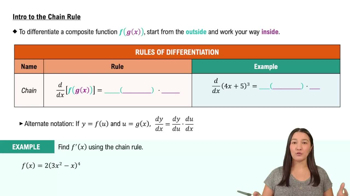
The Chain Rule is a formula for computing the derivative of a composite function. It states that if you have two functions, f(g(x)), the derivative can be found by multiplying the derivative of the outer function f with the derivative of the inner function g. This rule is particularly useful in the given problem, where the limit involves a composite function, allowing for the simplification of the differentiation process.
Video consigliato:
05:02
Intro to the Chain Rule

Derivatives

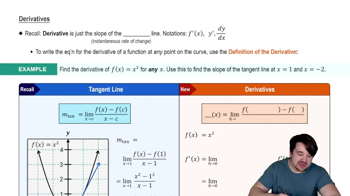
Derivatives represent the rate of change of a function with respect to its variable. They provide information about the slope of the tangent line to the function's graph at a given point. In this question, the limit expression is used to find the derivative of a composite function, which is essential for understanding how the function behaves locally around the point of interest.
Video consigliato:
Pratica correlata
Domanda del libro di testo

21–30. Derivatives

b. Evaluate f'(a) for the given values of a.

f(x) = 4x²+1; a= 2,4

367
views

Domanda del libro di testo

{Use of Tech} Angle of elevation A small plane, moving at 70 m/s, flies horizontally on a line 400 meters directly above an observer. Let θ be the angle of elevation of the plane (see figure). <IMAGE>


b. Graph dθ/dx as a function of x and determine the point at which θ changes most rapidly.

160
views
Domanda del libro di testo

The energy (in joules) released by an earthquake of magnitude M is given by the equation E=25,000 ⋅ 101.5M. (This equation can be solved for M to define the magnitude of a given earthquake; it is a refinement of the original Richter scale created by Charles Richter in 1935.)

Compute dE/dM and evaluate it for M=3. What does this derivative mean? (M has no units, so the units of the derivative are J per change in magnitude.)

267
views
Domanda del libro di testo

A differential equation is an equation involving an unknown function and its derivatives. Consider the differential equation y′′(t)+y(t) = 0.

b. Show that y = B cos t satisfies the equation for any constant B.

254
views
Domanda del libro di testo

13-26 Implicit differentiation Carry out the following steps.

b. Find the slope of the curve at the given point.

x⁴+y⁴ = 2;(1,−1)

277
views
Domanda del libro di testo

Volume of a torus The volume of a torus (doughnut or bagel) with an inner radius of a and an outer radius of b is V=π²(b+a)(b−a)²/4.

b. Evaluate this derivative when a=6 and b=10.

307
views