Ch. 3 - Derivatives
Briggs - Calculus: Early Transcendentals 3rd Edition
Briggs3rd EditionCalculus: Early TranscendentalsISBN: 9780136847243Non è quello che usi tu?Cambia libro di testo
Capitolo 3, Problema 3.8.17a

13-26 Implicit differentiation Carry out the following steps.
a. Use implicit differentiation to find dy/dx.
sin y = 5x⁴−5; (1, π)

Guida verificata passo dopo passo
1
Start by differentiating both sides of the equation with respect to x. The equation is \( \sin y = 5x^4 - 5 \).
For the left side, differentiate \( \sin y \) with respect to y, which gives \( \cos y \), and then multiply by \( \frac{dy}{dx} \) due to the chain rule. This results in \( \cos y \cdot \frac{dy}{dx} \).
For the right side, differentiate \( 5x^4 - 5 \) with respect to x. The derivative of \( 5x^4 \) is \( 20x^3 \), and the derivative of \(-5\) is 0. So, the right side becomes \( 20x^3 \).
Set the derivatives equal to each other: \( \cos y \cdot \frac{dy}{dx} = 20x^3 \).
Solve for \( \frac{dy}{dx} \) by dividing both sides by \( \cos y \), resulting in \( \frac{dy}{dx} = \frac{20x^3}{\cos y} \).

Risposta video verificata per un problema simile:

Questa soluzione video è stata consigliata dai nostri tutor come utile per risolvere questo problema.
Durata del video:
2m

Concetti chiave

Ecco i concetti essenziali che devi comprendere per rispondere correttamente alla domanda.

Implicit Differentiation

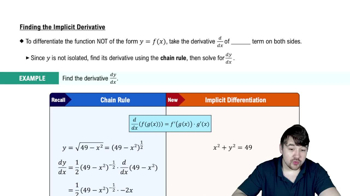
Implicit differentiation is a technique used to differentiate equations where the dependent and independent variables are not explicitly separated. Instead of solving for y in terms of x, we differentiate both sides of the equation with respect to x, treating y as a function of x. This method is particularly useful for equations that are difficult or impossible to rearrange.
Video consigliato:
Percorso guidato
05:14
Finding The Implicit Derivative

Chain Rule

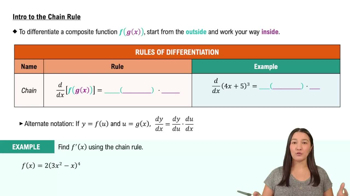
The chain rule is a fundamental principle in calculus that allows us to differentiate composite functions. When using implicit differentiation, the chain rule is applied to terms involving y, resulting in the derivative dy/dx. This means that when differentiating a function of y, we multiply by dy/dx to account for the dependence of y on x.
Video consigliato:
05:02
Intro to the Chain Rule

Evaluating at a Point

After finding the derivative dy/dx using implicit differentiation, we often need to evaluate it at a specific point, such as (1, π) in this case. This involves substituting the x and y values into the derived expression to find the slope of the tangent line at that point. This step is crucial for understanding the behavior of the function at specific coordinates.
Video consigliato:
04:50
Critical Points
Pratica correlata
Domanda del libro di testo

Find an equation of the line tangent to the following curves at the given value of x.

y = 4 sin x cos x; x = π/3

326
views

Domanda del libro di testo

45–50. Tangent lines Carry out the following steps. <IMAGE>

a. Verify that the given point lies on the curve.

x³+y³=2xy; (1, 1)

290
views
Domanda del libro di testo

7–14. Find the derivative the following ways:

a. Using the Product Rule (Exercises 7–10) or the Quotient Rule (Exercises 11–14). Simplify your result.

f(w) = w³ -w / w

238
views
Domanda del libro di testo

Airline travel The following figure shows the position function of an airliner on an out-and-back trip from Seattle to Minneapolis, where s = f(t) is the number of ground miles from Seattle t hours after take-off at 6:00 A.M. The plane returns to Seattle 8.5 hours later at 2:30 P.M. <IMAGE>

a. Calculate the average velocity of the airliner during the first 1.5 hours of the trip (0 ≤ t ≤ 1.5).

302
views
Domanda del libro di testo

The volume V of a sphere of radius r changes over time t.

a. Find an equation relating dV/dt to dr/dt.

334
views
Domanda del libro di testo

{Use of Tech} Approximating derivatives Assuming the limit exists, the definition of the derivative f′(a) = lim h→0 f(a + h) − f(a) / h implies that if ℎ is small, then an approximation to f′(a) is given by

f' (a) ≈ f(a+h) - f(a) / h. If ℎ > 0 , then this approximation is called a forward difference quotient; if ℎ < 0 , it is a backward difference quotient. As shown in the following exercises, these formulas are used to approximate f′ at a point when f is a complicated function or when f is represented by a set of data points. <IMAGE>

Let f (x) = √x.

a. Find the exact value of f' (4).

245
views