Ch. 3 - Derivatives
Briggs - Calculus: Early Transcendentals 3rd Edition
Briggs3rd EditionCalculus: Early TranscendentalsISBN: 9780136847243Non è quello che usi tu?Cambia libro di testo
Capitolo 3, Problema 3.9.66

63–74. Derivatives of logarithmic functions Calculate the derivative of the following functions. In some cases, it is useful to use the properties of logarithms to simplify the functions before computing f'(x).


y = log₈ |tan x|

Guida verificata passo dopo passo
1
First, recognize that the function y = log₈ |tan x| involves a logarithm with a base other than e or 10. To differentiate this, use the change of base formula: log₈ |tan x| = (log |tan x|) / (log 8).
Next, differentiate the expression (log |tan x|) / (log 8). Since log 8 is a constant, the derivative of y with respect to x is (1 / log 8) times the derivative of log |tan x|.
To differentiate log |tan x|, apply the chain rule. The derivative of log u with respect to u is 1/u, and the derivative of |tan x| with respect to x is the derivative of tan x times the derivative of |u| with respect to u.
The derivative of tan x is sec² x. Therefore, the derivative of |tan x| is sec² x times the sign of tan x, which is tan x / |tan x|.
Combine these results: the derivative of log |tan x| is (1 / |tan x|) * (tan x / |tan x|) * sec² x. Multiply this by (1 / log 8) to find the derivative of y = log₈ |tan x|.

Risposta video verificata per un problema simile:

Questa soluzione video è stata consigliata dai nostri tutor come utile per risolvere questo problema.
Durata del video:
5m

Concetti chiave

Ecco i concetti essenziali che devi comprendere per rispondere correttamente alla domanda.

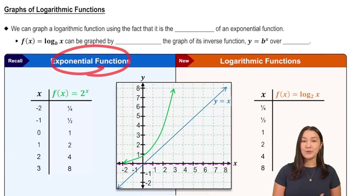
Logarithmic Functions

Logarithmic functions are the inverses of exponential functions and are defined as y = log_b(x), where b is the base and x is the argument. They have unique properties, such as log_b(xy) = log_b(x) + log_b(y) and log_b(x/y) = log_b(x) - log_b(y), which can simplify complex expressions. Understanding these properties is crucial for manipulating logarithmic expressions before differentiation.
Video consigliato:
5:26
Graphs of Logarithmic Functions

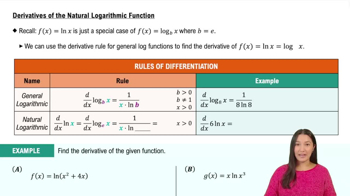
Derivative of Logarithmic Functions

The derivative of a logarithmic function can be computed using the formula d/dx[log_b(u)] = (1/(u ln(b))) * (du/dx), where u is a function of x. This formula highlights the chain rule in differentiation, as it requires finding the derivative of the inner function u. Mastery of this derivative is essential for solving problems involving logarithmic functions.
Video consigliato:
05:18
Derivative of the Natural Logarithmic Function

Properties of Derivatives

Understanding the properties of derivatives, such as the product rule, quotient rule, and chain rule, is vital for calculating derivatives of more complex functions. These rules allow for the differentiation of products, quotients, and compositions of functions systematically. Applying these rules correctly is necessary when dealing with functions that involve logarithms and trigonometric expressions, like tan(x) in the given problem.
Video consigliato:
Percorso guidato
06:21
Properties of Functions