Ch. 3 - Derivatives
Briggs - Calculus: Early Transcendentals 3rd Edition
Briggs3rd EditionCalculus: Early TranscendentalsISBN: 9780136847243Non è quello che usi tu?Cambia libro di testo
Capitolo 3, Problema 3.9.82

75–86. Logarithmic differentiation Use logarithmic differentiation to evaluate f'(x).
f(x) = x⁸cos³ x / √x-1

Guida verificata passo dopo passo
1
Step 1: Begin by taking the natural logarithm of both sides of the equation. This will help simplify the differentiation process. Write: ln(f(x)) = ln(x⁸cos³(x)/√(x-1)).
Step 2: Use the properties of logarithms to break down the expression. Apply the logarithm rules: ln(a/b) = ln(a) - ln(b) and ln(a^b) = b*ln(a). This gives: ln(f(x)) = 8ln(x) + 3ln(cos(x)) - (1/2)ln(x-1).
Step 3: Differentiate both sides with respect to x. Remember that the derivative of ln(f(x)) is (1/f(x)) * f'(x). For the right side, differentiate each term separately: d/dx[8ln(x)] = 8/x, d/dx[3ln(cos(x))] = -3sin(x)/cos(x), and d/dx[-(1/2)ln(x-1)] = -(1/2)/(x-1).
Step 4: Combine the derivatives from Step 3 to find the expression for f'(x)/f(x). This results in: f'(x)/f(x) = 8/x - 3tan(x) - 1/(2(x-1)).
Step 5: Solve for f'(x) by multiplying both sides by f(x). This gives: f'(x) = f(x) * (8/x - 3tan(x) - 1/(2(x-1))). Substitute f(x) = x⁸cos³(x)/√(x-1) back into the equation to express f'(x) in terms of x.

Risposta video verificata per un problema simile:

Questa soluzione video è stata consigliata dai nostri tutor come utile per risolvere questo problema.
Durata del video:
7m

Concetti chiave

Ecco i concetti essenziali che devi comprendere per rispondere correttamente alla domanda.

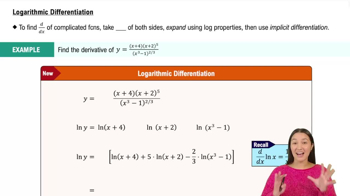
Logarithmic Differentiation

Logarithmic differentiation is a technique used to differentiate complex functions by taking the natural logarithm of both sides. This method simplifies the differentiation process, especially for products, quotients, or powers, by transforming multiplicative relationships into additive ones. It is particularly useful when dealing with functions that involve variable exponents or products of functions.
Video consigliato:
06:30
Logarithmic Differentiation

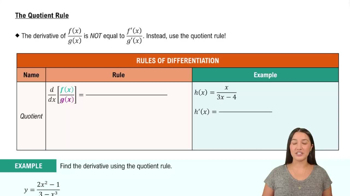
Product and Quotient Rules

The product rule and quotient rule are fundamental differentiation rules in calculus. The product rule states that the derivative of a product of two functions is the first function times the derivative of the second plus the second function times the derivative of the first. The quotient rule, on the other hand, provides a method for differentiating a quotient of two functions, ensuring that the derivative accounts for both the numerator and denominator.
Video consigliato:
06:43
The Quotient Rule

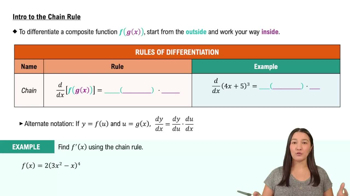
Chain Rule

The chain rule is a crucial differentiation technique used when differentiating composite functions. It states that the derivative of a composite function is the derivative of the outer function evaluated at the inner function, multiplied by the derivative of the inner function. This rule is essential for handling functions where one function is nested within another, allowing for accurate differentiation of complex expressions.
Video consigliato:
05:02
Intro to the Chain Rule