Ch. 3 - Derivatives
Briggs - Calculus: Early Transcendentals 3rd Edition
Briggs3rd EditionCalculus: Early TranscendentalsISBN: 9780136847243Non è quello che usi tu?Cambia libro di testo
Capitolo 3, Problema 43

Derivative calculations Evaluate the derivative of the following functions at the given point.
f(t) = 1/t+1; a=1

Guida verificata passo dopo passo
1
Step 1: Identify the function f(t) = \(\frac{1}{t}\) + 1 and the point a = 1 where we need to evaluate the derivative.
Step 2: Rewrite the function in a form that is easier to differentiate: f(t) = t^{-1} + 1.
Step 3: Differentiate the function using the power rule. The derivative of t^{-1} is -t^{-2}, and the derivative of a constant (1) is 0.
Step 4: Combine the results from the differentiation: f'(t) = -t^{-2}.
Step 5: Evaluate the derivative at the given point a = 1: f'(1) = -1^{-2}.

Risposta video verificata per un problema simile:

Questa soluzione video è stata consigliata dai nostri tutor come utile per risolvere questo problema.
Durata del video:
3m

Concetti chiave

Ecco i concetti essenziali che devi comprendere per rispondere correttamente alla domanda.

Derivative

The derivative of a function measures how the function's output value changes as its input value changes. It is defined as the limit of the average rate of change of the function over an interval as the interval approaches zero. In practical terms, the derivative provides the slope of the tangent line to the function's graph at a given point.
Video consigliato:

Limit

A limit is a fundamental concept in calculus that describes the behavior of a function as its input approaches a certain value. It is essential for defining derivatives and integrals. Understanding limits allows us to analyze functions that may not be well-defined at specific points, enabling the calculation of derivatives even when direct substitution is not possible.
Video consigliato:
05:50
One-Sided Limits

Function Evaluation

Function evaluation involves substituting a specific value into a function to determine its output. In the context of derivatives, evaluating the function at a particular point is crucial for finding the derivative at that point. This process often requires simplifying the function and applying the rules of calculus to derive the correct output.
Video consigliato:
Percorso guidato
4:26
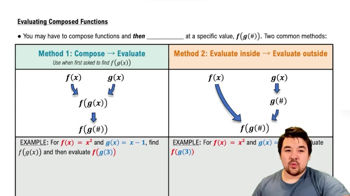
Evaluating Composed Functions