

Ch. 3 - Derivatives
Briggs - Calculus: Early Transcendentals 3rd Edition
Briggs3rd EditionCalculus: Early TranscendentalsISBN: 9780136847243Non è quello che usi tu?Cambia libro di testo
Capitolo 3, Problema 3.R.33

Evaluate and simplify y'.


y = ln w / w⁵

Guida verificata passo dopo passo
1
First, identify the given expression: y'.y = ln(w) / w⁵. This involves differentiation and simplification.
Recognize that y' represents the derivative of y with respect to w. We need to differentiate the expression on the right side with respect to w.
Apply the quotient rule for differentiation, which states that if you have a function u/v, its derivative is (u'v - uv') / v². Here, u = ln(w) and v = w⁵.
Differentiate u = ln(w) to get u' = 1/w. Differentiate v = w⁵ to get v' = 5w⁴.
Substitute these derivatives into the quotient rule formula: y' = [(1/w) * w⁵ - ln(w) * 5w⁴] / (w⁵)². Simplify the expression by combining like terms and reducing powers of w where possible.

Risposta video verificata per un problema simile:

Questa soluzione video è stata consigliata dai nostri tutor come utile per risolvere questo problema.
Durata del video:
4m

Concetti chiave

Ecco i concetti essenziali che devi comprendere per rispondere correttamente alla domanda.

Derivative

The derivative of a function measures how the function's output changes as its input changes. It is a fundamental concept in calculus, representing the slope of the tangent line to the curve at any given point. In this context, we need to apply the rules of differentiation to find y', the derivative of the function y with respect to w.
Video consigliato:

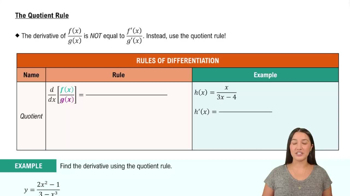
Quotient Rule

The quotient rule is a formula used to differentiate functions that are expressed as the quotient of two other functions. It states that if you have a function y = u/v, where both u and v are differentiable, then the derivative y' is given by (v * u' - u * v') / v². This rule is essential for simplifying the differentiation of y = ln(w) / w⁵.
Video consigliato:
06:43
The Quotient Rule

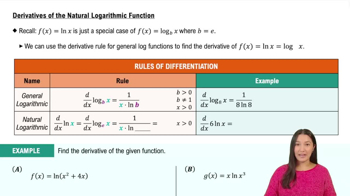
Natural Logarithm

The natural logarithm, denoted as ln, is the logarithm to the base e, where e is approximately 2.71828. It has unique properties, such as the derivative of ln(x) being 1/x. Understanding how to differentiate natural logarithmic functions is crucial for solving the given problem, as it involves ln(w) in the expression for y.
Video consigliato:
05:18
Derivative of the Natural Logarithmic Function