Ch. 3 - Derivatives
Briggs - Calculus: Early Transcendentals 3rd Edition
Briggs3rd EditionCalculus: Early TranscendentalsISBN: 9780136847243Non è quello che usi tu?Cambia libro di testo
Capitolo 3, Problema 3.10.35

Evaluate the derivative of the following functions.
f(x) = sec-1 (ln x)

Guida verificata passo dopo passo
1
First, recognize that the function f(x) = sec⁻¹(ln(x)) is a composition of functions, specifically the inverse secant function and the natural logarithm function. To find the derivative, we will use the chain rule.
Recall the derivative of the inverse secant function: if y = sec⁻¹(u), then dy/du = 1 / (|u|√(u² - 1)). In this case, u = ln(x).
Next, find the derivative of the inner function u = ln(x) with respect to x. The derivative of ln(x) is 1/x.
Apply the chain rule: the derivative of f(x) with respect to x is the derivative of sec⁻¹(u) with respect to u, multiplied by the derivative of u with respect to x. This gives us: df/dx = (1 / (|ln(x)|√((ln(x))² - 1))) * (1/x).
Simplify the expression obtained in the previous step to get the final form of the derivative. Ensure that the expression is correctly simplified and check for any domain restrictions based on the original function.

Risposta video verificata per un problema simile:

Questa soluzione video è stata consigliata dai nostri tutor come utile per risolvere questo problema.
Durata del video:
4m

Concetti chiave

Ecco i concetti essenziali che devi comprendere per rispondere correttamente alla domanda.

Derivative

The derivative of a function measures how the function's output value changes as its input value changes. It is defined as the limit of the average rate of change of the function over an interval as the interval approaches zero. Derivatives are fundamental in calculus for understanding rates of change and are used in various applications, including optimization and motion analysis.
Video consigliato:

Inverse Functions

An inverse function reverses the effect of the original function. For a function f(x), its inverse f<sup>-1</sup>(x) satisfies the condition f(f<sup>-1</sup>(x)) = x. In calculus, understanding how to differentiate inverse functions, such as sec<sup>-1</sup>(x), is crucial, as it often involves applying the chain rule and recognizing the relationship between a function and its inverse.
Video consigliato:
4:49
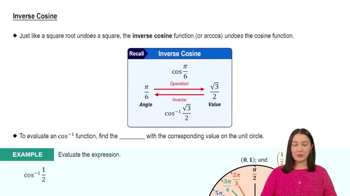
Inverse Cosine

Chain Rule

The chain rule is a fundamental technique in calculus used to differentiate composite functions. If a function y = f(g(x)) is composed of two functions, the chain rule states that the derivative dy/dx is the product of the derivative of the outer function evaluated at the inner function and the derivative of the inner function. This rule is essential for evaluating derivatives of functions like f(x) = sec<sup>-1</sup>(ln x), where ln x is nested within the sec<sup>-1</sup> function.
Video consigliato:
05:02
Intro to the Chain Rule