

Ch. 3 - Derivatives
Briggs - Calculus: Early Transcendentals 3rd Edition
Briggs3rd EditionCalculus: Early TranscendentalsISBN: 9780136847243Non è quello che usi tu?Cambia libro di testo
Capitolo 3, Problema 25

Evaluate the derivative of the following functions.
f(x) = x2 + 2x3 cot-1 x - ln (1 + x2)

Guida verificata passo dopo passo
1
To find the derivative of the function f(x) = x^2 + 2x^3 * cot^(-1)(x) - ln(1 + x^2), we will apply the rules of differentiation to each term separately.
Start with the first term, x^2. The derivative of x^2 with respect to x is 2x, using the power rule.
Next, consider the term 2x^3 * cot^(-1)(x). This is a product of two functions, so we will use the product rule: if u(x) = 2x^3 and v(x) = cot^(-1)(x), then the derivative is u'(x)v(x) + u(x)v'(x). Calculate u'(x) = 6x^2 and v'(x) = -1/(1 + x^2).
For the term -ln(1 + x^2), use the chain rule. The derivative of ln(u) is 1/u * du/dx. Here, u = 1 + x^2, so du/dx = 2x. Therefore, the derivative is -1/(1 + x^2) * 2x.
Combine the derivatives of each term to find the derivative of the entire function: f'(x) = 2x + (6x^2 * cot^(-1)(x) + 2x^3 * (-1/(1 + x^2))) - (2x/(1 + x^2)).

Risposta video verificata per un problema simile:

Questa soluzione video è stata consigliata dai nostri tutor come utile per risolvere questo problema.
Durata del video:
4m

Concetti chiave

Ecco i concetti essenziali che devi comprendere per rispondere correttamente alla domanda.

Derivative

The derivative of a function measures how the function's output value changes as its input value changes. It is defined as the limit of the average rate of change of the function over an interval as the interval approaches zero. Derivatives are fundamental in calculus for understanding rates of change and are denoted as f'(x) or df/dx.
Video consigliato:

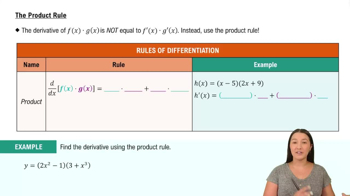
Product and Chain Rules

The product rule and chain rule are essential techniques for finding derivatives of more complex functions. The product rule states that the derivative of a product of two functions is the first function times the derivative of the second plus the second function times the derivative of the first. The chain rule is used when differentiating composite functions, stating that the derivative of f(g(x)) is f'(g(x)) * g'(x).
Video consigliato:
05:18
The Product Rule

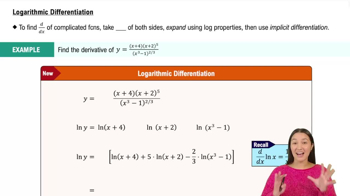
Logarithmic Differentiation

Logarithmic differentiation is a technique used to differentiate functions that are products or quotients of variables raised to powers. By taking the natural logarithm of both sides of the equation, it simplifies the differentiation process, especially when dealing with products or powers. This method is particularly useful for functions involving logarithms, as seen in the given function with ln(1 + x²).
Video consigliato:
06:30
Logarithmic Differentiation
Pratica correlata
Domanda del libro di testo

Suppose a stone is thrown vertically upward from the edge of a cliff on Earth with an initial velocity of 19.6 m/s from a height of 24.5 m above the ground. The height (in meters) of the stone above the ground t seconds after it is thrown is s(t) = -4.9t2 + 19.6t + 24.5.

On what intervals is the speed increasing?

305
views
Domanda del libro di testo

Suppose a baseball is thrown vertically upward from the ground with an initial velocity of v0 ft/s. The approximate height of the ball (in feet) above the ground after t seconds is given by s(t) = -16t² + v0t.

With what velocity does the ball strike the ground?

431
views
Domanda del libro di testo

Once Kate’s kite reaches a height of 50 ft (above her hands), it rises no higher but drifts due east in a wind blowing 5 ft/s. How fast is the string running through Kate’s hands at the moment when she has released 120 ft of string?

226
views
Domanda del libro di testo

Suppose a stone is thrown vertically upward from the edge of a cliff on Earth with an initial velocity of 32 ft/s from a height of 48 ft above the ground. The height (in feet) of the stone above the ground t seconds after it is thrown is s(t) = -16t2 + 32t + 48.

On what intervals is the speed increasing?

199
views
Domanda del libro di testo

Suppose a stone is thrown vertically upward from the edge of a cliff on Earth with an initial velocity of 64 ft/s from a height of 32 ft above the ground. The height (in feet) of the stone above the ground t seconds after it is thrown is s(t) = -16t2 + 64t + 32.

On what intervals is the speed increasing?

192
views
Domanda del libro di testo

Use definition (2) (p. 135) to find the slope of the line tangent to the graph of f at P.

f(x) = x3; P (1,1)

177
views