Ch. 3 - Derivatives
Briggs - Calculus: Early Transcendentals 3rd Edition
Briggs3rd EditionCalculus: Early TranscendentalsISBN: 9780136847243Non è quello che usi tu?Cambia libro di testo
Capitolo 3, Problema 85d

Finding derivatives from a table Find the values of the following derivatives using the table. <IMAGE>


d. d/dx (f(x)³) |x=5

Guida verificata passo dopo passo
1
Step 1: Recognize that you need to find the derivative of a composite function, specifically \( f(x)^3 \). This requires the use of the chain rule.
Step 2: Apply the chain rule. The chain rule states that the derivative of \( g(f(x)) \) is \( g'(f(x)) \cdot f'(x) \). Here, \( g(x) = x^3 \) and \( f(x) \) is the inner function.
Step 3: Differentiate \( g(x) = x^3 \) to get \( g'(x) = 3x^2 \). Therefore, \( g'(f(x)) = 3(f(x))^2 \).
Step 4: Multiply \( g'(f(x)) \) by \( f'(x) \) to get the derivative: \( \frac{d}{dx}(f(x)^3) = 3(f(x))^2 \cdot f'(x) \).
Step 5: Evaluate this expression at \( x = 5 \) using the values from the table for \( f(5) \) and \( f'(5) \). Substitute these values into the expression to find the derivative at \( x = 5 \).

Risposta video verificata per un problema simile:

Questa soluzione video è stata consigliata dai nostri tutor come utile per risolvere questo problema.
Durata del video:
3m

Concetti chiave

Ecco i concetti essenziali che devi comprendere per rispondere correttamente alla domanda.

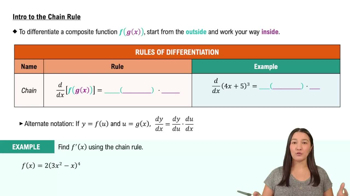
Chain Rule

The Chain Rule is a fundamental principle in calculus used to differentiate composite functions. It states that if you have a function that is composed of two or more functions, the derivative of the outer function is multiplied by the derivative of the inner function. For example, if y = f(g(x)), then dy/dx = f'(g(x)) * g'(x). This rule is essential for finding the derivative of f(x)³ in the given question.
Video consigliato:
05:02
Intro to the Chain Rule

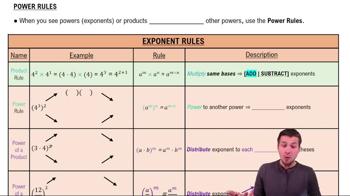
Power Rule

The Power Rule is a basic differentiation rule that states if f(x) = x^n, where n is a real number, then the derivative f'(x) = n*x^(n-1). This rule simplifies the process of finding derivatives of polynomial functions. In the context of the question, applying the Power Rule to f(x)³ will help in calculating the derivative needed at x=5.
Video consigliato:
5:50
Power Rules

Evaluating Derivatives at a Point

Evaluating derivatives at a specific point involves substituting the value of x into the derivative function after it has been calculated. This process provides the slope of the tangent line to the function at that particular point. In this case, after finding the derivative of f(x)³ using the Chain and Power Rules, you will substitute x=5 to find the required derivative value.
Video consigliato:
04:50
Critical Points