Ch. 3 - Derivatives
Briggs - Calculus: Early Transcendentals 3rd Edition
Briggs3rd EditionCalculus: Early TranscendentalsISBN: 9780136847243Non è quello che usi tu?Cambia libro di testo
Capitolo 3, Problema 3.2.7

If f is differentiable at a, must f be continuous at a?

Guida verificata passo dopo passo
1
Step 1: Understand the definitions. A function f is differentiable at a point a if the derivative f'(a) exists. This means that the limit of the difference quotient exists as x approaches a.
Step 2: Recall the definition of continuity. A function f is continuous at a point a if the limit of f(x) as x approaches a is equal to f(a).
Step 3: Connect differentiability and continuity. If f is differentiable at a, it implies that the limit of the difference quotient exists, which requires that the limit of f(x) as x approaches a must equal f(a).
Step 4: Conclude the relationship. Since differentiability at a point a implies that the function must be continuous at that point, f must be continuous at a if it is differentiable at a.
Step 5: Summarize the result. Differentiability at a point a implies continuity at that point, but the converse is not necessarily true; a function can be continuous at a point without being differentiable there.

Risposta video verificata per un problema simile:

Questa soluzione video è stata consigliata dai nostri tutor come utile per risolvere questo problema.
Durata del video:
3m

Concetti chiave

Ecco i concetti essenziali che devi comprendere per rispondere correttamente alla domanda.

Differentiability

A function f is said to be differentiable at a point a if the derivative f'(a) exists. This means that the limit of the difference quotient as x approaches a must exist. Differentiability implies that the function has a well-defined tangent at that point, which is a stronger condition than continuity.
Video consigliato:
Percorso guidato
05:53
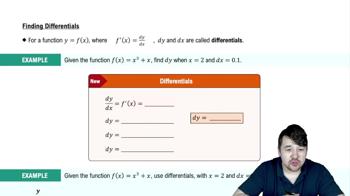
Finding Differentials

Continuity

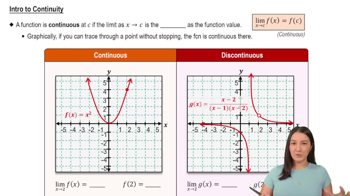
A function f is continuous at a point a if the limit of f(x) as x approaches a equals f(a). This means there are no jumps, breaks, or holes in the graph of the function at that point. Continuity ensures that small changes in x result in small changes in f(x), allowing for a smooth transition.
Video consigliato:
05:34
Intro to Continuity

Relationship Between Differentiability and Continuity

If a function is differentiable at a point a, it must also be continuous at that point. This is because the existence of the derivative requires that the function does not have any discontinuities at a. However, the converse is not true; a function can be continuous at a point without being differentiable there.
Video consigliato:
05:34
Intro to Continuity