Ch. 3 - Derivatives
Briggs - Calculus: Early Transcendentals 3rd Edition
Briggs3rd EditionCalculus: Early TranscendentalsISBN: 9780136847243Non è quello che usi tu?Cambia libro di testo
Capitolo 3, Problema 35c

Determine whether the following statements are true and give an explanation or counterexample.
c. It is impossible for the instantaneous velocity at all times a≤t≤b to equal the average velocity over the interval a≤t≤b.

Guida verificata passo dopo passo
1
To determine if the statement is true, we need to understand the concepts of instantaneous velocity and average velocity. Instantaneous velocity is the velocity of an object at a specific moment in time, while average velocity is the total displacement divided by the total time over an interval.
Consider a scenario where an object moves with constant velocity. In this case, the instantaneous velocity at any time \( t \) within the interval \( a \leq t \leq b \) is the same as the constant velocity.
For constant velocity, the average velocity over the interval \( a \leq t \leq b \) is calculated as the total displacement divided by the total time, which is equal to the constant velocity itself.
Thus, if the object moves with constant velocity, the instantaneous velocity at all times \( a \leq t \leq b \) is equal to the average velocity over the interval.
Therefore, the statement is false. A counterexample is an object moving with constant velocity, where the instantaneous velocity at all times equals the average velocity over the interval.

Risposta video verificata per un problema simile:

Questa soluzione video è stata consigliata dai nostri tutor come utile per risolvere questo problema.
Durata del video:
5m

Concetti chiave

Ecco i concetti essenziali che devi comprendere per rispondere correttamente alla domanda.

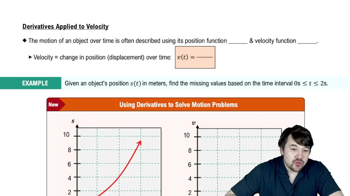
Instantaneous Velocity

Instantaneous velocity refers to the velocity of an object at a specific moment in time. It is defined mathematically as the limit of the average velocity as the time interval approaches zero. This concept is crucial for understanding how an object's speed changes at any given point, and it is represented by the derivative of the position function with respect to time.
Video consigliato:
Percorso guidato
06:29
Derivatives Applied To Velocity

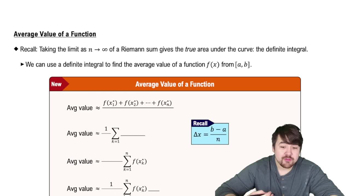
Average Velocity

Average velocity is defined as the total displacement divided by the total time taken over a specific interval. It provides a measure of the overall change in position of an object during that interval. The average velocity can be calculated using the formula (s(b) - s(a)) / (b - a), where s(t) is the position function at times a and b.
Video consigliato:
Percorso guidato
06:37
Average Value of a Function

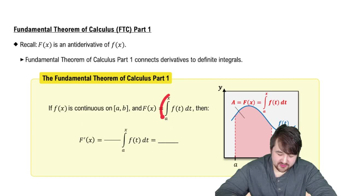
Mean Value Theorem

The Mean Value Theorem states that if a function is continuous on a closed interval [a, b] and differentiable on the open interval (a, b), then there exists at least one point c in (a, b) where the instantaneous velocity (the derivative) equals the average velocity over that interval. This theorem is essential for understanding the relationship between instantaneous and average velocities, and it provides a counterexample to the statement in the question.
Video consigliato:
Percorso guidato
06:11
Fundamental Theorem of Calculus Part 1