Ch. 3 - Derivatives
Briggs - Calculus: Early Transcendentals 3rd Edition
Briggs3rd EditionCalculus: Early TranscendentalsISBN: 9780136847243Non è quello che usi tu?Cambia libro di testo
Capitolo 3, Problema 3.8.84

Orthogonal trajectories Two curves are orthogonal to each other if their tangent lines are perpendicular at each point of intersection (recall that two lines are perpendicular to each other if their slopes are negative reciprocals). A family of curves forms orthogonal trajectories with another family of curves if each curve in one family is orthogonal to each curve in the other family. For example, the parabolas y = cx² form orthogonal trajectories with the family of ellipses x²+2y² = k, where c and k are constants (see figure).
Find dy/dx for each equation of the following pairs. Use the derivatives to explain why the families of curves form orthogonal trajectories. <IMAGE>


y = cx²; x²+2y² = k, where c and k are constants

Guida verificata passo dopo passo
1
Step 1: Start by finding the derivative of the first family of curves, y = cx². Differentiate both sides with respect to x to find dy/dx. This will give you the slope of the tangent line to the parabola at any point.
Step 2: Differentiate the equation of the second family of curves, x² + 2y² = k, implicitly with respect to x. This involves using the chain rule for the term 2y², as y is a function of x.
Step 3: Solve the implicit differentiation from Step 2 for dy/dx. This will give you the slope of the tangent line to the ellipse at any point.
Step 4: Compare the expressions for dy/dx obtained from both families of curves. For the curves to be orthogonal trajectories, the product of their slopes (dy/dx from each family) at any point of intersection should be -1, indicating that the slopes are negative reciprocals.
Step 5: Verify that the product of the slopes from Step 1 and Step 3 is indeed -1. This confirms that the families of curves are orthogonal trajectories, as their tangent lines are perpendicular at each point of intersection.

Risposta video verificata per un problema simile:

Questa soluzione video è stata consigliata dai nostri tutor come utile per risolvere questo problema.
Durata del video:
3m

Concetti chiave

Ecco i concetti essenziali che devi comprendere per rispondere correttamente alla domanda.

Orthogonal Trajectories

Orthogonal trajectories are pairs of curves that intersect at right angles. This means that at each point of intersection, the slopes of the tangent lines to the curves are negative reciprocals of each other. For example, if one curve has a slope of m, the other must have a slope of -1/m. This concept is crucial for understanding how different families of curves relate to each other geometrically.

Derivatives and Slopes

The derivative of a function at a given point represents the slope of the tangent line to the curve at that point. In the context of orthogonal trajectories, calculating the derivatives of the given curves allows us to determine their slopes at points of intersection. By showing that these slopes are negative reciprocals, we can confirm that the curves are indeed orthogonal to each other.
Video consigliato:
Percorso guidato
05:13
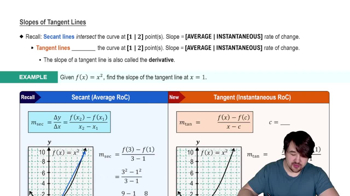
Slopes of Tangent Lines

Families of Curves

A family of curves refers to a set of curves defined by a common equation that includes one or more parameters. For instance, the parabolas defined by y = cx² form a family where 'c' varies. Similarly, the ellipses defined by x² + 2y² = k form another family. Understanding how these families interact, particularly in terms of orthogonality, is essential for solving problems involving their relationships.
Video consigliato:
11:41
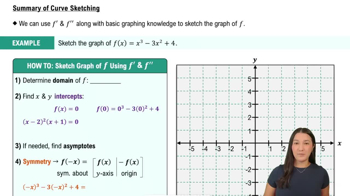
Summary of Curve Sketching