Ch. 3 - Derivatives
Briggs - Calculus: Early Transcendentals 3rd Edition
Briggs3rd EditionCalculus: Early TranscendentalsISBN: 9780136847243Non è quello che usi tu?Cambia libro di testo
Capitolo 3, Problema 66a

Population growth Consider the following population functions.
a. Find the instantaneous growth rate of the population, for t≥0.
p(t) = 600 (t²+3/t²+9)

Guida verificata passo dopo passo
1
Step 1: Identify the function for which you need to find the instantaneous growth rate. The function given is \( p(t) = 600 \left( \frac{t^2 + 3}{t^2 + 9} \right) \).
Step 2: To find the instantaneous growth rate, you need to compute the derivative of the function \( p(t) \) with respect to \( t \). This involves using the quotient rule for differentiation.
Step 3: Recall the quotient rule: if you have a function \( \frac{u(t)}{v(t)} \), its derivative is \( \frac{u'(t)v(t) - u(t)v'(t)}{(v(t))^2} \). Here, \( u(t) = t^2 + 3 \) and \( v(t) = t^2 + 9 \).
Step 4: Differentiate \( u(t) \) and \( v(t) \) separately. \( u'(t) = 2t \) and \( v'(t) = 2t \).
Step 5: Apply the quotient rule: \( p'(t) = 600 \left( \frac{(2t)(t^2 + 9) - (t^2 + 3)(2t)}{(t^2 + 9)^2} \right) \). Simplify the expression to find the derivative.

Risposta video verificata per un problema simile:

Questa soluzione video è stata consigliata dai nostri tutor come utile per risolvere questo problema.
Durata del video:
4m

Concetti chiave

Ecco i concetti essenziali che devi comprendere per rispondere correttamente alla domanda.

Instantaneous Growth Rate

The instantaneous growth rate of a function at a given point is defined as the derivative of that function at that point. In the context of population growth, it represents how fast the population is changing at a specific time, providing insight into trends and future projections.
Video consigliato:
Percorso guidato
04:16
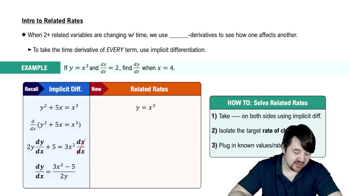
Intro To Related Rates

Derivatives

A derivative measures how a function changes as its input changes. In calculus, it is a fundamental tool used to find rates of change, slopes of tangent lines, and to analyze the behavior of functions. For population functions, derivatives help determine growth rates and can indicate whether a population is increasing or decreasing.
Video consigliato:

Population Functions

Population functions are mathematical models that describe how a population changes over time. They can take various forms, such as linear, exponential, or polynomial functions. Understanding the specific form of the population function is crucial for applying calculus techniques to analyze growth rates and predict future population sizes.
Video consigliato:
Percorso guidato
06:21
Properties of Functions