Ch. 3 - Derivatives
Briggs - Calculus: Early Transcendentals 3rd Edition
Briggs3rd EditionCalculus: Early TranscendentalsISBN: 9780136847243Non è quello che usi tu?Cambia libro di testo
Capitolo 3, Problema 20a

Position, velocity, and acceleration Suppose the position of an object moving horizontally along a line after t seconds is given by the following functions s = f(t), where s is measured in feet, with s > 0 corresponding to positions right of the origin.
a. Graph the position function.
f(t)=6t3+36t2−54t;0≤t≤4f(t)=6t^3+36t^2-54t;0\(\le\) t\(\le\)4

Guida verificata passo dopo passo
1
Step 1: Understand the position function given by \( f(t) = 6t^3 + 36t^2 - 54t \) for \( 0 \leq t \leq 4 \). This function describes the position of an object moving along a line over time.
Step 2: Identify the key features of the function to graph it. These include finding the intercepts, critical points, and inflection points. Start by finding the y-intercept by evaluating \( f(0) \).
Step 3: Find the critical points by taking the derivative of the position function to get the velocity function \( f'(t) = 18t^2 + 72t - 54 \). Set \( f'(t) = 0 \) and solve for \( t \) to find the critical points.
Step 4: Determine the nature of the critical points (whether they are maxima, minima, or points of inflection) by using the second derivative test. Compute the second derivative \( f''(t) = 36t + 72 \) and evaluate it at the critical points.
Step 5: Use the information from the intercepts, critical points, and the behavior of the function as \( t \to 0 \) and \( t \to 4 \) to sketch the graph of the position function \( f(t) \) over the interval \( 0 \leq t \leq 4 \).

Risposta video verificata per un problema simile:

Questa soluzione video è stata consigliata dai nostri tutor come utile per risolvere questo problema.
Durata del video:
9m

Concetti chiave

Ecco i concetti essenziali che devi comprendere per rispondere correttamente alla domanda.

Position Function

The position function, denoted as s = f(t), describes the location of an object at any given time t. In this context, the function f(t) = 6t³ + 36t² - 54t represents the position of the object in feet as a function of time in seconds. Understanding this function is crucial for analyzing the object's movement along a line.
Video consigliato:
Percorso guidato
5:20
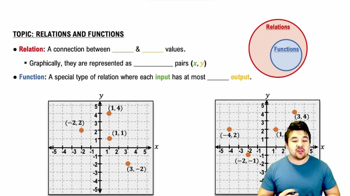
Relations and Functions

Graphing Functions

Graphing the position function involves plotting the values of f(t) against time t on a coordinate system. This visual representation helps in understanding the behavior of the object over the specified interval (0 ≤ t ≤ 4). It allows one to observe key features such as the object's position at specific times, trends in movement, and any changes in direction.
Video consigliato:
Percorso guidato
5:53
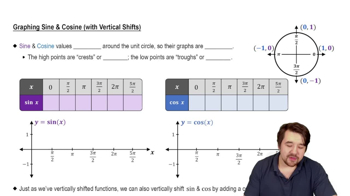
Graph of Sine and Cosine Function

Calculus and Motion

Calculus plays a vital role in analyzing motion through concepts like velocity and acceleration, which are derived from the position function. The velocity is the first derivative of the position function, indicating how fast the position changes over time, while acceleration is the second derivative, showing how the velocity changes. These concepts are essential for understanding the dynamics of the object's movement.
Video consigliato:
Percorso guidato
06:29
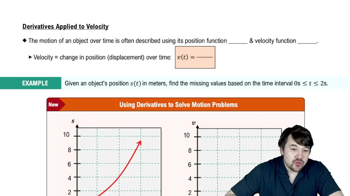
Derivatives Applied To Velocity