

Ch. 3 - Derivatives
Briggs - Calculus: Early Transcendentals 3rd Edition
Briggs3rd EditionCalculus: Early TranscendentalsISBN: 9780136847243Non è quello che usi tu?Cambia libro di testo
Capitolo 3, Problema 3.10.5

Suppose f is a one-to-one function with f(2)=8 and f′(2)=4. What is the value of (f^−1)′(8)?

Guida verificata passo dopo passo
1
Step 1: Recall the formula for the derivative of the inverse function. If f is a one-to-one function and differentiable at a point, then the derivative of its inverse function at a point is given by: \((f^{-1})'(b) = \frac{1}{f'(a)}\), where \(f(a) = b\).
Step 2: Identify the given values in the problem. We know that \(f(2) = 8\) and \(f'(2) = 4\).
Step 3: Match the given values to the formula. Here, \(a = 2\) and \(b = 8\), so we need to find \((f^{-1})'(8)\).
Step 4: Substitute the known values into the formula. Using \((f^{-1})'(b) = \frac{1}{f'(a)}\), substitute \(f'(2) = 4\) into the formula to find \((f^{-1})'(8)\).
Step 5: Calculate the expression \((f^{-1})'(8) = \frac{1}{4}\). This gives the value of the derivative of the inverse function at the point where \(f(x) = 8\).

Risposta video verificata per un problema simile:

Questa soluzione video è stata consigliata dai nostri tutor come utile per risolvere questo problema.
Durata del video:
2m

Concetti chiave

Ecco i concetti essenziali che devi comprendere per rispondere correttamente alla domanda.

Inverse Function Theorem

The Inverse Function Theorem states that if a function f is continuously differentiable and has a non-zero derivative at a point, then its inverse function f⁻¹ is also differentiable at the corresponding point. Specifically, if f'(a) ≠ 0, then (f⁻¹)'(f(a)) = 1 / f'(a). This theorem is crucial for finding the derivative of an inverse function.
Video consigliato:
4:49
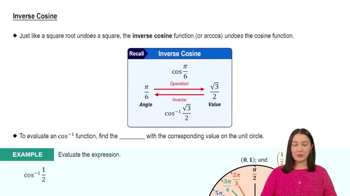
Inverse Cosine

One-to-One Function

A one-to-one function, or injective function, is a function where each output is produced by exactly one input. This property ensures that the function has an inverse, as it guarantees that for every y in the range, there is a unique x in the domain such that f(x) = y. In this problem, knowing that f is one-to-one allows us to confidently apply the Inverse Function Theorem.
Video consigliato:
05:50
One-Sided Limits

Derivative of a Function

The derivative of a function at a point measures the rate at which the function's value changes as its input changes. It is defined as the limit of the average rate of change as the interval approaches zero. In this context, f′(2) = 4 indicates that at x = 2, the function f is increasing at a rate of 4 units of output for every 1 unit of input, which is essential for calculating the derivative of the inverse function.
Video consigliato:
06:30
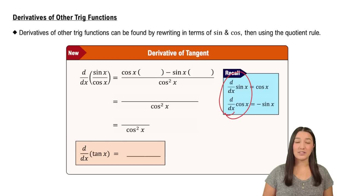
Derivatives of Other Trig Functions