Ch. 3 - Derivatives
Briggs - Calculus: Early Transcendentals 3rd Edition
Briggs3rd EditionCalculus: Early TranscendentalsISBN: 9780136847243Non è quello che usi tu?Cambia libro di testo
Capitolo 3, Problema 74a

Suppose f(3) = 1 and f′(3) = 4. Let g(x) = x2 + f(x) and h(x) = 3f(x).
Find an equation of the line tangent to y = g(x) at x = 3.

Guida verificata passo dopo passo
1
Step 1: Identify the function g(x) and its components. We have g(x) = x^2 + f(x).
Step 2: To find the equation of the tangent line, we need the slope at x = 3. This requires finding g'(x), the derivative of g(x).
Step 3: Differentiate g(x) = x^2 + f(x) to get g'(x) = 2x + f'(x).
Step 4: Substitute x = 3 into g'(x) to find the slope of the tangent line: g'(3) = 2(3) + f'(3).
Step 5: Use the point-slope form of a line, y - y_1 = m(x - x_1), where m is the slope from Step 4, and (x_1, y_1) is the point (3, g(3)). Calculate g(3) using g(3) = 3^2 + f(3).

Risposta video verificata per un problema simile:

Questa soluzione video è stata consigliata dai nostri tutor come utile per risolvere questo problema.
Durata del video:
6m

Concetti chiave

Ecco i concetti essenziali che devi comprendere per rispondere correttamente alla domanda.

Tangent Line

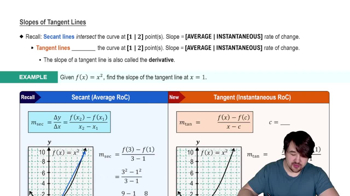
A tangent line to a curve at a given point is a straight line that touches the curve at that point without crossing it. The slope of the tangent line is given by the derivative of the function at that point. For a function g(x), the equation of the tangent line at x = a can be expressed as y = g(a) + g'(a)(x - a).
Video consigliato:
Percorso guidato
05:13
Slopes of Tangent Lines

Derivative

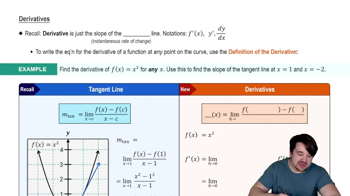
The derivative of a function measures how the function's output changes as its input changes. It is defined as the limit of the average rate of change of the function as the interval approaches zero. In this context, f'(3) = 4 indicates that at x = 3, the function f is increasing at a rate of 4 units of output for every 1 unit of input.
Video consigliato:

Function Composition

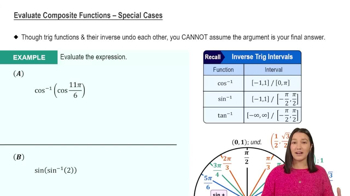
Function composition involves combining two functions to create a new function. In this case, g(x) = x² + f(x) combines the polynomial function x² with the function f(x). Understanding how to differentiate composite functions is essential for finding the derivative g'(x), which is necessary for determining the slope of the tangent line.
Video consigliato:
3:48
Evaluate Composite Functions - Special Cases
Pratica correlata
Domanda del libro di testo

{Use of Tech} The Witch of Agnesi The graph of y = a3 / (x2 + a2), where a is a constant, is called the witch of Agnesi (named after the 18th-century Italian mathematician Maria Agnesi).

Let a = 3 and find an equation of the line tangent to y = 27 / (x2 + 9) at x = 2.

304
views
Domanda del libro di testo

Find an equation of the line tangent to the following curves at the given value of x.

y = 1+2 sin x; x = π/6

186
views
Domanda del libro di testo

Tangent lines Suppose f(2)=2 and f′(2) =3. Let g(x) = x²f(x) and h(x) = f(x) / x−3.

b. Find an equation of the line tangent to y = h(x) at x=2.

294
views
Domanda del libro di testo

The right-sided and left-sided derivatives of a function at a point aa are given by f+′(a)=limh→0+f(a+h)−f(a)hf_{+}^{\(\prime\)}\(\left\)(a\(\right\))={\(\displaystyle\)\(\lim\)_{h\(\to\)0^{+}}{\(\frac{f(a+h)-f(a)}{h}\)}} and f−′(a)=limh→0−f(a+h)−f(a)hf_{-}^{\(\prime\)}\(\left\)(a\(\right\))={\(\displaystyle\)\(\lim\)_{h\(\to\)0^{-}}{\(\frac{f(a+h)-f(a)}{h}\)}}, respectively, provided these limits exist. The derivative f′(a)f^{\(\prime\)}\(\left\)(a\(\right\)) exists if and only if f+′(a)=f−′(a)f_{+}^{\(\prime\)}\(\left\)(a\(\right\))=f_{-}^{\(\prime\)}\(\left\)(a\(\right\)).

Compute f+′(a)f_{+}^{\(\prime\)}\(\left\)(a\(\right\)) and f−′(a)f_{-}^{\(\prime\)}\(\left\)(a\(\right\)) at the given point aa.

f(x)={4−x2 if x≤12x+1 if x>1f(x)=\(\begin{cases}\)4-x^2~\(\text{if}\)~x\(\leq{1}\)\\2x+1~\(\text{if}\)~x\(\gt{1}\)\(\end{cases}\); a=1a=1

252
views
Domanda del libro di testo

Calculate the derivative of the following functions.

y = (p+3)² sin p²

339
views
Domanda del libro di testo

27–76. Calculate the derivative of the following functions.

y = √f(x), where f is differentiable and nonnegative at x.

414
views