Ch. 3 - Derivatives
Briggs - Calculus: Early Transcendentals 3rd Edition
Briggs3rd EditionCalculus: Early TranscendentalsISBN: 9780136847243Non è quello che usi tu?Cambia libro di testo
Capitolo 3, Problema 92a

Suppose the line tangent to the graph of f at x=2 is y=4x+1 and suppose y=3x−2 is the line tangent to the graph of g at x=2. Find an equation of the line tangent to the following curves at x=2.
y = f(x)g(x)

Guida verificata passo dopo passo
1
Step 1: Identify the given information. We have two functions, f(x) and g(x), with their respective tangent lines at x=2. The tangent line to f(x) at x=2 is y=4x+1, which implies that f'(2)=4 and f(2) is the y-value when x=2, which can be found by substituting x=2 into the equation of the tangent line. Similarly, the tangent line to g(x) at x=2 is y=3x−2, which implies that g'(2)=3 and g(2) is the y-value when x=2, found by substituting x=2 into the equation of the tangent line.
Step 2: Use the product rule to find the derivative of y=f(x)g(x). The product rule states that if y=u(x)v(x), then y'=u'(x)v(x) + u(x)v'(x). Here, u(x)=f(x) and v(x)=g(x), so y'=f'(x)g(x) + f(x)g'(x).
Step 3: Substitute x=2 into the derivative found in Step 2. This gives y'(2)=f'(2)g(2) + f(2)g'(2).
Step 4: Substitute the known values from Step 1 into the expression from Step 3. We have f'(2)=4, g'(2)=3, and the values of f(2) and g(2) can be found from the tangent line equations.
Step 5: Use the result from Step 4 to write the equation of the tangent line to y=f(x)g(x) at x=2. The equation of a tangent line is y-y_1=m(x-x_1), where m is the slope found in Step 4, and (x_1, y_1) is the point on the curve at x=2, which can be found by evaluating y=f(x)g(x) at x=2.

Risposta video verificata per un problema simile:

Questa soluzione video è stata consigliata dai nostri tutor come utile per risolvere questo problema.
Durata del video:
6m

Concetti chiave

Ecco i concetti essenziali che devi comprendere per rispondere correttamente alla domanda.

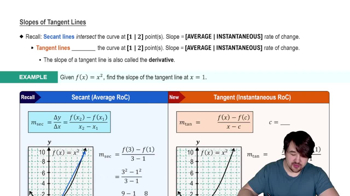
Tangent Line

A tangent line to a curve at a given point is a straight line that touches the curve at that point without crossing it. The slope of the tangent line represents the derivative of the function at that point, indicating the rate of change of the function. In this problem, the equations of the tangent lines for functions f and g at x=2 provide the necessary slopes for further calculations.
Video consigliato:
Percorso guidato
05:13
Slopes of Tangent Lines

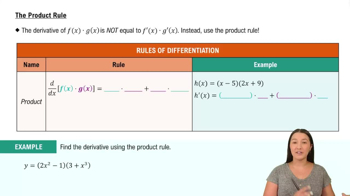
Product Rule

The Product Rule is a fundamental differentiation rule used when finding the derivative of the product of two functions. It states that if u(x) and v(x) are two differentiable functions, then the derivative of their product is given by u'v + uv'. This rule is essential for determining the derivative of the product of f(x) and g(x) at x=2 in the given problem.
Video consigliato:
05:18
The Product Rule

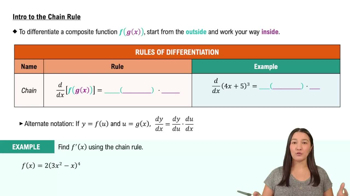
Chain Rule

The Chain Rule is a method for differentiating composite functions. It states that if a function y is composed of another function u, then the derivative of y with respect to x is the derivative of y with respect to u multiplied by the derivative of u with respect to x. While not directly applied in this problem, understanding the Chain Rule is important for more complex scenarios involving nested functions.
Video consigliato:
05:02
Intro to the Chain Rule