Ch. 3 - Derivatives
Briggs - Calculus: Early Transcendentals 3rd Edition
Briggs3rd EditionCalculus: Early TranscendentalsISBN: 9780136847243Non è quello che usi tu?Cambia libro di testo
Capitolo 3, Problema 3.8.42a

Surface area of a cone The lateral surface area of a cone of radius r and height h (the surface area excluding the base) is A = πr√r²+h².
a. Find dr/dh for a cone with a lateral surface area of A=1500π.

Guida verificata passo dopo passo
1
Start with the formula for the lateral surface area of a cone: A = πr√(r² + h²). We are given that A = 1500π.
Set up the equation 1500π = πr√(r² + h²). Divide both sides by π to simplify: 1500 = r√(r² + h²).
To find dr/dh, we need to differentiate both sides of the equation with respect to h. First, express r in terms of h if possible, or use implicit differentiation.
Differentiate the equation 1500 = r√(r² + h²) with respect to h. Use the product rule and chain rule as necessary. The derivative of the left side is 0 since it's a constant.
Solve the resulting equation for dr/dh. This will involve isolating dr/dh on one side of the equation, which may require algebraic manipulation and simplification.

Risposta video verificata per un problema simile:

Questa soluzione video è stata consigliata dai nostri tutor come utile per risolvere questo problema.
Durata del video:
6m

Concetti chiave

Ecco i concetti essenziali che devi comprendere per rispondere correttamente alla domanda.

Lateral Surface Area of a Cone

The lateral surface area of a cone is the area of the cone's curved surface, excluding the base. It is calculated using the formula A = πr√(r² + h²), where r is the radius and h is the height of the cone. Understanding this formula is essential for solving problems related to the surface area of cones.
Video consigliato:
09:07
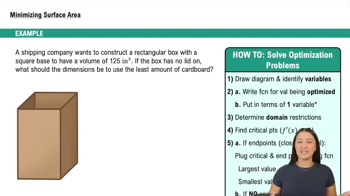
Example 1: Minimizing Surface Area

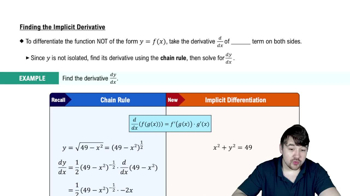
Implicit Differentiation

Implicit differentiation is a technique used to differentiate equations where the dependent and independent variables are not isolated. In this context, it allows us to find the rate of change of one variable with respect to another, such as dr/dh, without explicitly solving for one variable in terms of the other. This is particularly useful when dealing with relationships defined by equations like the surface area of a cone.
Video consigliato:
Percorso guidato
05:14
Finding The Implicit Derivative

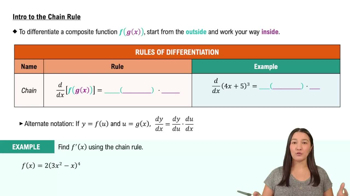
Chain Rule

The chain rule is a fundamental principle in calculus used to differentiate composite functions. It states that if a variable y depends on u, which in turn depends on x, then the derivative of y with respect to x can be found by multiplying the derivative of y with respect to u by the derivative of u with respect to x. This rule is crucial for finding derivatives like dr/dh when multiple variables are involved.
Video consigliato:
05:02
Intro to the Chain Rule