Ch. 3 - Derivatives
Briggs - Calculus: Early Transcendentals 3rd Edition
Briggs3rd EditionCalculus: Early TranscendentalsISBN: 9780136847243Non è quello che usi tu?Cambia libro di testo
Capitolo 3, Problema 82a

The following limits represent f'(a) for some function f and some real number a.
Find a possible function f and number a.
lim x🠂0 e^x-1 / x

Guida verificata passo dopo passo
1
Step 1: Recognize that the given limit \( \lim_{x \to 0} \frac{e^x - 1}{x} \) is a standard limit that represents the derivative of the exponential function \( f(x) = e^x \) at a specific point.
Step 2: Recall the definition of the derivative \( f'(a) \) for a function \( f(x) \) at a point \( a \), which is given by \( \lim_{x \to a} \frac{f(x) - f(a)}{x - a} \).
Step 3: Compare the given limit with the derivative definition. Notice that the form \( \frac{e^x - 1}{x} \) suggests \( f(x) = e^x \) and \( f(a) = e^0 = 1 \).
Step 4: Identify that the limit \( \lim_{x \to 0} \frac{e^x - 1}{x} \) is equivalent to finding \( f'(0) \) for the function \( f(x) = e^x \).
Step 5: Conclude that a possible function \( f \) is \( f(x) = e^x \) and the number \( a \) is 0, since the derivative \( f'(0) \) is represented by the given limit.

Risposta video verificata per un problema simile:

Questa soluzione video è stata consigliata dai nostri tutor come utile per risolvere questo problema.
Durata del video:
3m

Concetti chiave

Ecco i concetti essenziali che devi comprendere per rispondere correttamente alla domanda.

Limits

Limits are fundamental in calculus, representing the value that a function approaches as the input approaches a certain point. In this context, the limit as x approaches 0 of (e^x - 1) / x is crucial for determining the derivative of the function at that point. Understanding limits allows us to analyze the behavior of functions near specific values, which is essential for defining derivatives.
Video consigliato:
05:50
One-Sided Limits

Derivatives

The derivative of a function at a point quantifies the rate at which the function's value changes as its input changes. It is defined as the limit of the average rate of change of the function as the interval approaches zero. In this case, the limit provided represents the derivative of the function f at the point a, which is a key concept in understanding how functions behave locally.
Video consigliato:

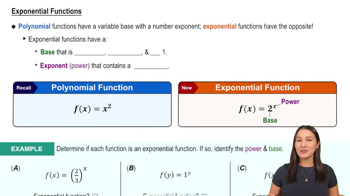
Exponential Functions

Exponential functions, such as e^x, are functions of the form f(x) = a^x, where 'a' is a constant. The function e^x is particularly important in calculus due to its unique property that its derivative is equal to itself. This property simplifies the process of finding derivatives and limits involving exponential functions, making them a common subject in calculus problems.
Video consigliato:
6:13
Exponential Functions