Ch. 3 - Derivatives
Briggs - Calculus: Early Transcendentals 3rd Edition
Briggs3rd EditionCalculus: Early TranscendentalsISBN: 9780136847243Non è quello che usi tu?Cambia libro di testo
Capitolo 3, Problema 13c

The legs of an isosceles right triangle increase in length at a rate of 2 m/s.
c. At what rate is the length of the hypotenuse changing?

Guida verificata passo dopo passo
1
Identify the relationship between the sides of an isosceles right triangle. The legs are equal, and the hypotenuse can be found using the Pythagorean theorem: \( c = \sqrt{2}a \), where \( a \) is the length of each leg and \( c \) is the hypotenuse.
Differentiate the Pythagorean theorem with respect to time \( t \) to find the rate of change of the hypotenuse. Start with \( c^2 = a^2 + a^2 = 2a^2 \).
Apply implicit differentiation to \( c^2 = 2a^2 \) with respect to \( t \): \( 2c \frac{dc}{dt} = 4a \frac{da}{dt} \).
Solve for \( \frac{dc}{dt} \), the rate of change of the hypotenuse: \( \frac{dc}{dt} = \frac{2a \frac{da}{dt}}{c} \).
Substitute the given rate of change of the legs \( \frac{da}{dt} = 2 \) m/s and the expression for \( c = \sqrt{2}a \) into the equation to find \( \frac{dc}{dt} \).

Risposta video verificata per un problema simile:

Questa soluzione video è stata consigliata dai nostri tutor come utile per risolvere questo problema.
Durata del video:
2m

Concetti chiave

Ecco i concetti essenziali che devi comprendere per rispondere correttamente alla domanda.

Isosceles Right Triangle Properties

An isosceles right triangle has two equal sides and a right angle between them. The lengths of the legs are denoted as 'a', and the hypotenuse 'c' can be calculated using the Pythagorean theorem: c = a√2. Understanding these properties is essential for relating the sides of the triangle to each other.
Video consigliato:
Percorso guidato
06:21
Properties of Functions

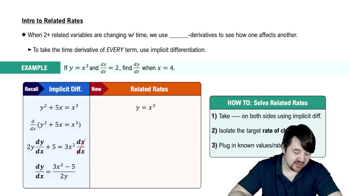
Related Rates

Related rates involve finding the rate at which one quantity changes in relation to another. In this problem, we need to determine how the length of the hypotenuse changes as the lengths of the legs increase. This requires applying differentiation to the relationship between the sides of the triangle.
Video consigliato:
Percorso guidato
04:16
Intro To Related Rates

Differentiation

Differentiation is a fundamental concept in calculus that deals with finding the rate of change of a function. In this context, we will differentiate the equation relating the legs and the hypotenuse with respect to time to find the rate at which the hypotenuse is changing as the legs grow.
Video consigliato:
Percorso guidato
05:53
Finding Differentials