
Ch. 3 - Derivatives
Briggs - Calculus: Early Transcendentals 3rd Edition
Briggs3rd EditionCalculus: Early TranscendentalsISBN: 9780136847243Non è quello che usi tu?Cambia libro di testo
Capitolo 3, Problema 3.17

The line tangent to the graph of f at x=5 is y = 1/10x-2. Find d/dx (4f(x)) |x+5

Guida verificata passo dopo passo
1
Step 1: Understand the problem. We need to find the derivative of the function 4f(x) at x = 5. The tangent line equation y = \(\frac{1}{10}\)x - 2 gives us information about the derivative of f(x) at x = 5.
Step 2: Recall that the slope of the tangent line to the graph of f at x = 5 is the derivative of f at that point, f'(5). From the equation y = \(\frac{1}{10}\)x - 2, the slope is \(\frac{1}{10}\). Therefore, f'(5) = \(\frac{1}{10}\).
Step 3: Use the constant multiple rule for derivatives. The derivative of 4f(x) with respect to x is 4f'(x).
Step 4: Substitute x = 5 into the derivative expression. We have 4f'(5).
Step 5: Substitute the value of f'(5) from Step 2 into the expression from Step 4. This gives us 4 \(\times\) \(\frac{1}{10}\).

Risposta video verificata per un problema simile:

Questa soluzione video è stata consigliata dai nostri tutor come utile per risolvere questo problema.
Durata del video:
2m

Concetti chiave

Ecco i concetti essenziali che devi comprendere per rispondere correttamente alla domanda.

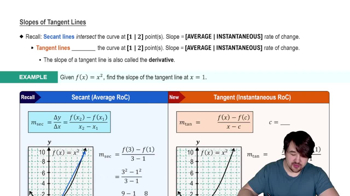
Tangent Line

A tangent line to a curve at a given point is a straight line that touches the curve at that point without crossing it. The slope of the tangent line represents the instantaneous rate of change of the function at that point, which is given by the derivative. In this case, the equation of the tangent line provides the slope and y-intercept needed to understand the behavior of the function f near x=5.
Video consigliato:
Percorso guidato
05:13
Slopes of Tangent Lines

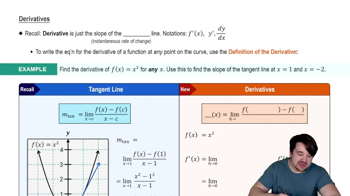
Derivative

The derivative of a function measures how the function's output changes as its input changes. It is defined as the limit of the average rate of change of the function over an interval as the interval approaches zero. In this problem, we need to find the derivative of 4f(x) at x = -5, which involves applying the rules of differentiation to the function f.
Video consigliato:

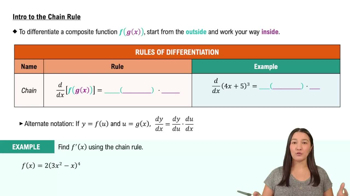
Chain Rule

The chain rule is a fundamental theorem in calculus used to differentiate composite functions. It states that if a function y = f(g(x)) is composed of two functions, the derivative can be found by multiplying the derivative of the outer function by the derivative of the inner function. In this context, understanding how to apply the chain rule will be essential for differentiating 4f(x) effectively.
Video consigliato:
05:02
Intro to the Chain Rule
Pratica correlata
Domanda del libro di testo

Two boats leave a port at the same time, one traveling west at 20 mi/hr and the other traveling southwest ( 45° south of west) at 15 mi/hr. After 30 minutes, how far apart are the boats and at what rate is the distance between them changing? (Hint: Use the Law of Cosines.)

326
views
Domanda del libro di testo

Another method for proving lim x→0 cos x−1/x = 0 Use the half-angle formula sin²x = 1− cos 2x/2 to prove that lim x→0 cos x−1/x=0.

370
views
Domanda del libro di testo

Find the derivative of the following functions.

y = In(e^x + e^-x)

337
views
Domanda del libro di testo

90–93. {Use of Tech} Work carefully Proceed with caution when using implicit differentiation to find points at which a curve has a specified slope. For the following curves, find the points on the curve (if they exist) at which the tangent line is horizontal or vertical. Once you have found possible points, make sure that they actually lie on the curve. Confirm your results with a graph.

x²(3y²−2y³) = 4

371
views
Domanda del libro di testo

The speed of sound (in m/s) in dry air is approximated the function v(T) = 331 + 0.6T, where T is the air temperature (in degrees Celsius). Evaluate v' (T) and interpret its meaning.

339
views
Domanda del libro di testo

Interpreting the derivative Find the derivative of each function at the given point and interpret the physical meaning of this quantity. Include units in your answer.

An object dropped from rest falls d(t)=16t² feet in t seconds. Find d′(4).

263
views