Ch. 3 - Derivatives
Briggs - Calculus: Early Transcendentals 3rd Edition
Briggs3rd EditionCalculus: Early TranscendentalsISBN: 9780136847243Non è quello che usi tu?Cambia libro di testo
Capitolo 3, Problema 96

{Use of Tech} Beak length The length of the culmen (the upper ridge of a bird’s bill) of a t-week-old Indian spotted owlet is modeled by the function L(t)=11.94 / 1 + 4e^−1.65t, where L is measured in millimeters.


a. Find L′(1) and interpret the meaning of this value.

Guida verificata passo dopo passo
1
First, identify the function given: L(t) = \(\frac{11.94}{1 + 4e^{-1.65t}\)}. This is a rational function where the numerator is a constant and the denominator is a function of t.
To find L'(t), we need to differentiate L(t) with respect to t. This requires using the quotient rule for differentiation, which states that if you have a function \(\frac{u(t)}{v(t)}\), its derivative is \(\frac{u'(t)v(t) - u(t)v'(t)}{(v(t))^2}\).
In our case, u(t) = 11.94 and v(t) = 1 + 4e^{-1.65t}. The derivative of u(t), u'(t), is 0 because it is a constant. For v(t), apply the chain rule to find v'(t). The derivative of 4e^{-1.65t} is -6.6e^{-1.65t} (using the chain rule).
Substitute these derivatives into the quotient rule formula: L'(t) = \(\frac{0 \cdot (1 + 4e^{-1.65t}\)) - 11.94 \(\cdot\) (-6.6e^{-1.65t})}{(1 + 4e^{-1.65t})^2}. Simplify the expression to find L'(t).
Finally, evaluate L'(1) by substituting t = 1 into the derivative expression. This value represents the rate of change of the culmen length at t = 1 week, indicating how quickly the length is increasing at that specific time.

Risposta video verificata per un problema simile:

Questa soluzione video è stata consigliata dai nostri tutor come utile per risolvere questo problema.
Durata del video:
3m

Concetti chiave

Ecco i concetti essenziali che devi comprendere per rispondere correttamente alla domanda.

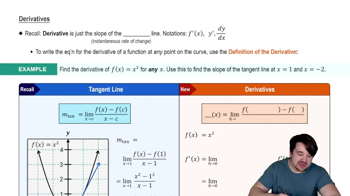
Derivative

The derivative of a function measures the rate at which the function's value changes as its input changes. In this context, L'(t) represents the instantaneous rate of change of the culmen length L with respect to time t. Calculating L'(1) will provide insight into how quickly the beak length is growing at t = 1 week.
Video consigliato:

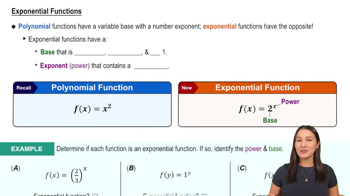
Exponential Function

The function L(t) includes an exponential term, e^(-1.65t), which influences the growth behavior of the beak length over time. Exponential functions are characterized by their rapid increase or decrease, depending on the sign of the exponent. Understanding this concept is crucial for interpreting how the beak length evolves as the owlet ages.
Video consigliato:
6:13
Exponential Functions

Interpretation of Derivatives

Interpreting the value of a derivative involves understanding its practical significance in a real-world context. For L'(1), this means analyzing what the calculated rate of change indicates about the growth of the owlet's beak at one week old, such as whether it is growing rapidly, slowly, or not at all, which can have implications for the bird's development.
Video consigliato: