Ch. 3 - Derivatives
Briggs - Calculus: Early Transcendentals 3rd Edition
Briggs3rd EditionCalculus: Early TranscendentalsISBN: 9780136847243Non è quello che usi tu?Cambia libro di testo
Capitolo 3, Problema 3.6.50a

{Use of Tech} Tree growth Let b represent the base diameter of a conifer tree and let h represent the height of the tree, where b is measured in centimeters and h is measured in meters. Assume the height is related to the base diameter by the function h = 5.67+0.70b+0.0067b².
a. Graph the height function.

Guida verificata passo dopo passo
1
Understand the function: The height of the tree, h, is given by the quadratic function h = 5.67 + 0.70b + 0.0067b², where b is the base diameter in centimeters and h is the height in meters.
Identify the type of function: This is a quadratic function in terms of b, which means its graph will be a parabola. Since the coefficient of b² is positive (0.0067), the parabola opens upwards.
Determine the vertex: The vertex of a parabola given by the function h = ax² + bx + c can be found using the formula b = -B/(2A), where A is the coefficient of b² and B is the coefficient of b. In this case, A = 0.0067 and B = 0.70.
Calculate the vertex: Substitute A and B into the vertex formula to find the base diameter b at the vertex. Then, substitute this value of b back into the original function to find the corresponding height h.
Plot the graph: Use the vertex and additional points by choosing various values of b to calculate corresponding h values. Plot these points on a graph with b on the x-axis and h on the y-axis to visualize the height function as a parabola opening upwards.

Risposta video verificata per un problema simile:

Questa soluzione video è stata consigliata dai nostri tutor come utile per risolvere questo problema.
Durata del video:
1m

Concetti chiave

Ecco i concetti essenziali che devi comprendere per rispondere correttamente alla domanda.

Quadratic Functions

The given height function h = 5.67 + 0.70b + 0.0067b² is a quadratic function, which is characterized by its parabolic shape. Quadratic functions can be represented in the standard form ax² + bx + c, where a, b, and c are constants. The coefficient of the b² term (0.0067) indicates that the parabola opens upwards, and its vertex represents the minimum point of the function.
Video consigliato:
6:04
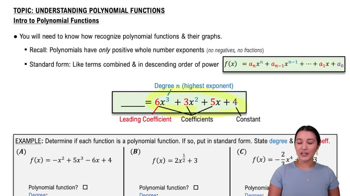
Introduction to Polynomial Functions

Graphing Functions

Graphing a function involves plotting points on a coordinate system to visualize the relationship between the variables. For the height function, the x-axis can represent the base diameter (b), while the y-axis represents the height (h). Understanding how to identify key features such as intercepts, vertex, and the direction of the parabola is essential for accurately graphing the function.
Video consigliato:
Percorso guidato
5:53
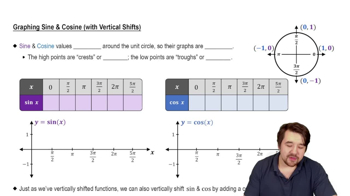
Graph of Sine and Cosine Function

Interpreting Parameters

In the function h = 5.67 + 0.70b + 0.0067b², the parameters have specific meanings: the constant term (5.67) represents the height when the base diameter is zero, the linear term (0.70b) indicates the rate of change of height with respect to diameter, and the quadratic term (0.0067b²) shows how the growth rate changes as the diameter increases. Understanding these parameters helps in interpreting the function's behavior and its implications for tree growth.
Video consigliato:
03:55
The Quotient Rule Example 5