Ch. 3 - Derivatives
Briggs - Calculus: Early Transcendentals 3rd Edition
Briggs3rd EditionCalculus: Early TranscendentalsISBN: 9780136847243Non è quello che usi tu?Cambia libro di testo
Capitolo 3, Problema 3.2.43a

Use the definition of the derivative to determine d/dx(ax²+bx+c), where a, b, and c are constants.

Guida verificata passo dopo passo
1
Step 1: Recall the definition of the derivative. The derivative of a function f(x) at a point x is given by the limit: \( f'(x) = \lim_{h \to 0} \frac{f(x+h) - f(x)}{h} \).
Step 2: Identify the function f(x) = ax^2 + bx + c. We need to find f(x+h) by substituting x with (x+h) in the function: f(x+h) = a(x+h)^2 + b(x+h) + c.
Step 3: Expand f(x+h). Use the distributive property to expand: a(x+h)^2 = a(x^2 + 2xh + h^2), and b(x+h) = bx + bh. So, f(x+h) = ax^2 + 2axh + ah^2 + bx + bh + c.
Step 4: Substitute f(x) and f(x+h) into the derivative definition: \( f'(x) = \lim_{h \to 0} \frac{(ax^2 + 2axh + ah^2 + bx + bh + c) - (ax^2 + bx + c)}{h} \).
Step 5: Simplify the expression inside the limit. Cancel out the terms ax^2, bx, and c, and then divide each remaining term by h: \( f'(x) = \lim_{h \to 0} \frac{2axh + ah^2 + bh}{h} = \lim_{h \to 0} (2ax + ah + b) \). Finally, evaluate the limit as h approaches 0.

Risposta video verificata per un problema simile:

Questa soluzione video è stata consigliata dai nostri tutor come utile per risolvere questo problema.
Durata del video:
4m

Concetti chiave

Ecco i concetti essenziali che devi comprendere per rispondere correttamente alla domanda.

Definition of the Derivative

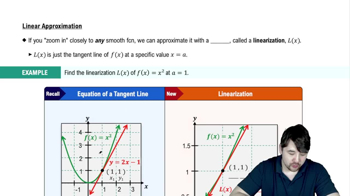
The derivative of a function at a point measures the rate at which the function's value changes as its input changes. Formally, it is defined as the limit of the average rate of change of the function as the interval approaches zero. This concept is foundational in calculus, as it provides a way to understand how functions behave locally.
Video consigliato:
Percorso guidato
05:43
Definition of the Definite Integral

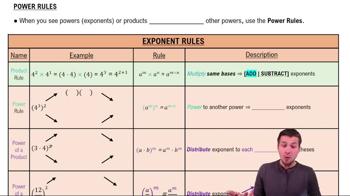
Power Rule

The power rule is a basic differentiation rule that states if f(x) = x^n, then f'(x) = n*x^(n-1), where n is a constant. This rule simplifies the process of finding derivatives for polynomial functions, making it easier to differentiate terms like ax², bx, and c in the given expression.
Video consigliato:
5:50
Power Rules

Linearity of Derivatives

The linearity of derivatives refers to the property that the derivative of a sum of functions is the sum of their derivatives, and the derivative of a constant multiplied by a function is the constant multiplied by the derivative of the function. This principle allows for the straightforward differentiation of polynomial expressions by treating each term independently.
Video consigliato: