
Domanda del libro di testo
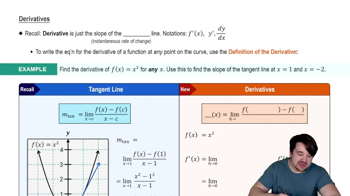
Use the definition of the derivative to evaluate the following limits.
272
views

 Guida verificata passo dopo passo
 05:44
05:44
 05:36
05:36 05:50
05:50Use the definition of the derivative to evaluate the following limits.
The population of the United States (in millions) by decade is given in the table, where t is the number of years after 1910. These data are plotted and fitted with a smooth curve y = p(t) in the figure. <IMAGE><IMAGE>
Estimate the instantaneous rate of growth in 1985.
Suppose the cost of producing x lawn mowers is C(x) = −0.02x²+400x+5000.
a. Determine the average and marginal costs for x = 3000 lawn mowers.
Suppose the cost of producing x lawn mowers is C(x) = −0.02x²+400x+5000.
b. Interpret the meaning of your results in part (a).
The population of the United States (in millions) by decade is given in the table, where t is the number of years after 1910. These data are plotted and fitted with a smooth curve y = p(t) in the figure. <IMAGE><IMAGE>
Explain why the average rate of growth from 1950 to 1960 is a good approximation to the (instantaneous) rate of growth in 1955.
Product Rule for three functions Assume f, g, and h are differentiable at x.
a. Use the Product Rule (twice) to find a formula for d/dx (f(x)g(x)h(x)).