Ch. 3 - Derivatives
Briggs - Calculus: Early Transcendentals 3rd Edition
Briggs3rd EditionCalculus: Early TranscendentalsISBN: 9780136847243Non è quello che usi tu?Cambia libro di testo
Capitolo 3, Problema 12

Use the table to find the following derivatives.
<IMAGE>
d/dx (f(x) + g(x)) ∣x=1

Guida verificata passo dopo passo
1
Step 1: Recall the sum rule for derivatives, which states that the derivative of a sum of functions is the sum of their derivatives. In mathematical terms, this is expressed as \( \frac{d}{dx} [f(x) + g(x)] = f'(x) + g'(x) \).
Step 2: Identify the point at which you need to evaluate the derivative, which is \( x = 1 \) in this problem.
Step 3: Use the table provided in the problem to find the values of \( f'(1) \) and \( g'(1) \). These are the derivatives of \( f(x) \) and \( g(x) \) evaluated at \( x = 1 \).
Step 4: Substitute the values of \( f'(1) \) and \( g'(1) \) from the table into the expression \( f'(1) + g'(1) \).
Step 5: Simplify the expression to find the value of the derivative \( \frac{d}{dx} (f(x) + g(x)) \) at \( x = 1 \).

Risposta video verificata per un problema simile:

Questa soluzione video è stata consigliata dai nostri tutor come utile per risolvere questo problema.
Durata del video:
2m

Concetti chiave

Ecco i concetti essenziali che devi comprendere per rispondere correttamente alla domanda.

Derivative

A derivative represents the rate at which a function changes at a given point. It is defined as the limit of the average rate of change of the function as the interval approaches zero. In calculus, the derivative is often denoted as f'(x) or df/dx, and it provides crucial information about the function's behavior, such as its slope and concavity.
Video consigliato:

Sum Rule of Derivatives

The Sum Rule states that the derivative of the sum of two functions is equal to the sum of their derivatives. Mathematically, if f(x) and g(x) are differentiable functions, then d/dx (f(x) + g(x)) = f'(x) + g'(x). This rule simplifies the process of finding derivatives when dealing with the addition of functions.
Video consigliato:
Percorso guidato
05:44
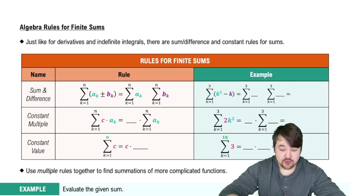
Algebra Rules for Finite Sums

Evaluating Derivatives at a Point

Evaluating a derivative at a specific point involves substituting the value of that point into the derivative function. For example, to find d/dx (f(x) + g(x)) at x=1, you first compute f'(1) and g'(1) using the derivatives obtained from the Sum Rule, and then add these values together to get the final result.
Video consigliato:
04:50
Critical Points