Ch. 3 - Derivatives
Briggs - Calculus: Early Transcendentals 3rd Edition
Briggs3rd EditionCalculus: Early TranscendentalsISBN: 9780136847243Non è quello che usi tu?Cambia libro di testo
Capitolo 3, Problema 3.5.15

Use Theorem 3.10 to evaluate the following limits.
lim x🠂0 (tan 5x) / x

Guida verificata passo dopo passo
1
Theorem 3.10 refers to the limit of the form lim x→0 (sin(ax)/x) = a, which is a standard result in calculus.
To use this theorem, we need to express tan(5x) in terms of sine and cosine: tan(5x) = sin(5x)/cos(5x).
Rewrite the original limit as lim x→0 (sin(5x)/cos(5x)) / x, which can be rearranged to lim x→0 (sin(5x)/(x * cos(5x))).
Separate the limit into two parts: lim x→0 (sin(5x)/x) * lim x→0 (1/cos(5x)).
Apply Theorem 3.10 to the first part: lim x→0 (sin(5x)/x) = 5, and evaluate the second part: lim x→0 (1/cos(5x)) = 1, since cos(0) = 1.

Risposta video verificata per un problema simile:

Questa soluzione video è stata consigliata dai nostri tutor come utile per risolvere questo problema.
Durata del video:
4m

Concetti chiave

Ecco i concetti essenziali che devi comprendere per rispondere correttamente alla domanda.

Limits

Limits are fundamental in calculus, representing the value that a function approaches as the input approaches a certain point. They are essential for understanding continuity, derivatives, and integrals. In this context, evaluating the limit as x approaches 0 helps determine the behavior of the function tan(5x)/x near that point.
Video consigliato:
05:50
One-Sided Limits

Theorem 3.10 (Limit of a Trigonometric Function)

Theorem 3.10 typically refers to a specific limit involving trigonometric functions, often stating that lim x→0 (sin x)/x = 1. This theorem can be extended to other functions, such as tan(5x), by recognizing that tan(x) behaves similarly to sin(x) near zero, allowing us to simplify the limit evaluation.
Video consigliato:
Percorso guidato
6:04
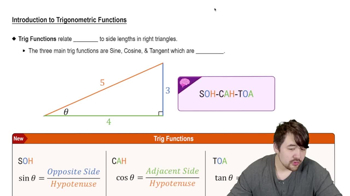
Introduction to Trigonometric Functions

L'Hôpital's Rule

L'Hôpital's Rule is a method for evaluating limits that result in indeterminate forms like 0/0 or ∞/∞. It states that if such a form occurs, the limit of the ratio of two functions can be found by taking the derivative of the numerator and the derivative of the denominator. This rule can be applied to the limit in the question if direct substitution leads to an indeterminate form.
Video consigliato:
5:50
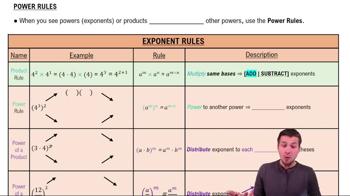
Power Rules