Ch. 3 - Derivatives
Briggs - Calculus: Early Transcendentals 3rd Edition
Briggs3rd EditionCalculus: Early TranscendentalsISBN: 9780136847243Non è quello che usi tu?Cambia libro di testo
Capitolo 3, Problema 3.5.21

Use Theorem 3.10 to evaluate the following limits.
lim x🠂0 sin ax / sin bx, where a and b are constants with b ≠ 0.

Guida verificata passo dopo passo
1
Theorem 3.10 is the standard limit result: lim x→0 (sin x)/x = 1. This theorem is useful for evaluating limits involving sine functions as x approaches 0.
To evaluate lim x→0 (sin(ax)/sin(bx)), we can rewrite it as (sin(ax)/ax) * (bx/sin(bx)) * (a/b).
Apply Theorem 3.10 to each sine term: lim x→0 (sin(ax)/ax) = 1 and lim x→0 (bx/sin(bx)) = 1.
Combine the results from the application of Theorem 3.10: lim x→0 (sin(ax)/sin(bx)) = (1) * (1) * (a/b).
Thus, the limit evaluates to a/b, which is the final expression for the given limit problem.

Risposta video verificata per un problema simile:

Questa soluzione video è stata consigliata dai nostri tutor come utile per risolvere questo problema.
Durata del video:
3m

Concetti chiave

Ecco i concetti essenziali che devi comprendere per rispondere correttamente alla domanda.

Theorem 3.10 (Limit Theorem)

Theorem 3.10 typically refers to a limit theorem that helps evaluate the limit of a quotient of functions. In this case, it likely states that if the limits of the numerator and denominator both approach zero, the limit of their quotient can be evaluated using L'Hôpital's Rule or by simplifying the expression. Understanding this theorem is crucial for solving limits that result in indeterminate forms.
Video consigliato:
Percorso guidato
06:11
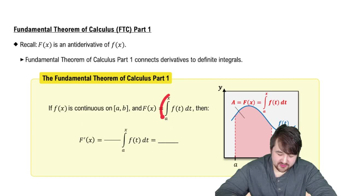
Fundamental Theorem of Calculus Part 1

Sine Function Behavior Near Zero

The sine function has a well-known behavior as it approaches zero, specifically that lim x→0 (sin x)/x = 1. This property is essential for evaluating limits involving sine functions, as it allows us to rewrite expressions in a more manageable form. Recognizing how sine behaves near zero is key to simplifying the limit in the given problem.
Video consigliato:
Percorso guidato
2:18
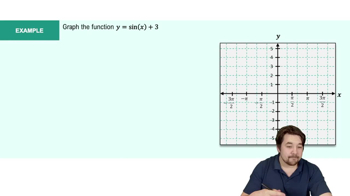
Graph of Sine and Cosine Function Example 1

Constant Multiplication in Limits

When evaluating limits, constants can be factored out of the limit expression. This means that if a limit involves constants multiplied by functions, those constants can be treated separately. In the context of the given limit, understanding how to handle the constants 'a' and 'b' will help simplify the expression and arrive at the correct limit value.
Video consigliato:
05:50
One-Sided Limits