Ch. 4 - Applications of the Derivative
Briggs - Calculus: Early Transcendentals 3rd Edition
Briggs3rd EditionCalculus: Early TranscendentalsISBN: 9780136847243Non è quello che usi tu?Cambia libro di testo
Capitolo 4, Problema 4.7.28

17–83. Limits Evaluate the following limits. Use l’Hôpital’s Rule when it is convenient and applicable.


lim_x→ 0⁺ (x - 3 √x) / (x - √x)

Guida verificata passo dopo passo
1
Identify the form of the limit as x approaches 0 from the positive side. Substitute x = 0 into the expression (x - 3√x) / (x - √x) to check if it results in an indeterminate form like 0/0.
Since substituting x = 0 gives 0/0, l'Hôpital's Rule can be applied. This rule states that if the limit of f(x)/g(x) as x approaches a point results in an indeterminate form, then the limit can be found by differentiating the numerator and the denominator separately.
Differentiate the numerator: The numerator is x - 3√x. The derivative of x is 1, and the derivative of 3√x is (3/2)x^(-1/2). Therefore, the derivative of the numerator is 1 - (3/2)x^(-1/2).
Differentiate the denominator: The denominator is x - √x. The derivative of x is 1, and the derivative of √x is (1/2)x^(-1/2). Therefore, the derivative of the denominator is 1 - (1/2)x^(-1/2).
Apply l'Hôpital's Rule: Take the limit of the new expression formed by the derivatives of the numerator and the denominator as x approaches 0 from the positive side. Evaluate lim_x→0⁺ [(1 - (3/2)x^(-1/2)) / (1 - (1/2)x^(-1/2))].

Risposta video verificata per un problema simile:

Questa soluzione video è stata consigliata dai nostri tutor come utile per risolvere questo problema.
Durata del video:
4m

Concetti chiave

Ecco i concetti essenziali che devi comprendere per rispondere correttamente alla domanda.

Limits

Limits are fundamental concepts in calculus that describe the behavior of a function as its input approaches a certain value. They help in understanding the function's behavior near points of interest, including points where the function may not be explicitly defined. Evaluating limits is crucial for determining continuity, derivatives, and integrals.
Video consigliato:
05:50
One-Sided Limits

L'Hôpital's Rule

L'Hôpital's Rule is a method used to evaluate limits that result in indeterminate forms, such as 0/0 or ∞/∞. The rule states that if the limit of f(x)/g(x) results in an indeterminate form, the limit can be found by taking the derivative of the numerator and the derivative of the denominator separately, then re-evaluating the limit. This technique simplifies the process of finding limits in complex functions.
Video consigliato:
5:50
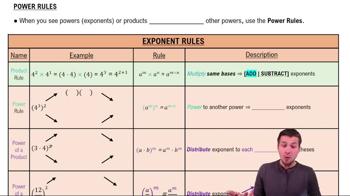
Power Rules

Square Roots and Their Properties

Square roots are mathematical functions that return the non-negative value whose square equals the given number. Understanding how to manipulate square roots is essential in calculus, especially when evaluating limits involving expressions with square roots. Simplifying expressions with square roots can often help in resolving indeterminate forms and making limits easier to compute.
Video consigliato:
Percorso guidato
06:21
Properties of Functions