Ch. 4 - Applications of the Derivative
Briggs - Calculus: Early Transcendentals 3rd Edition
Briggs3rd EditionCalculus: Early TranscendentalsISBN: 9780136847243Non è quello che usi tu?Cambia libro di testo
Capitolo 4, Problema 4.7.27

17–83. Limits Evaluate the following limits. Use l’Hôpital’s Rule when it is convenient and applicable.


lim_x→ 0⁺ (1 - ln x) / (1 + ln x)

Guida verificata passo dopo passo
1
First, identify the form of the limit as x approaches 0 from the positive side. Substitute x = 0⁺ into the expression (1 - ln x) / (1 + ln x) to check if it results in an indeterminate form like 0/0 or ∞/∞.
Since ln(x) approaches -∞ as x approaches 0⁺, both the numerator (1 - ln x) and the denominator (1 + ln x) approach ∞, resulting in the indeterminate form ∞/∞. This indicates that l'Hôpital's Rule can be applied.
Apply l'Hôpital's Rule, which states that if the limit of f(x)/g(x) as x approaches a point results in an indeterminate form, then the limit can be evaluated as the limit of f'(x)/g'(x) as x approaches the same point, provided the derivatives exist.
Differentiate the numerator: The derivative of 1 - ln x with respect to x is -1/x.
Differentiate the denominator: The derivative of 1 + ln x with respect to x is 1/x.

Risposta video verificata per un problema simile:

Questa soluzione video è stata consigliata dai nostri tutor come utile per risolvere questo problema.
Durata del video:
2m

Concetti chiave

Ecco i concetti essenziali che devi comprendere per rispondere correttamente alla domanda.

Limits

Limits are fundamental concepts in calculus that describe the behavior of a function as its input approaches a certain value. They help in understanding the function's behavior near points of interest, including points where the function may not be defined. Evaluating limits is crucial for determining continuity, derivatives, and integrals.
Video consigliato:
05:50
One-Sided Limits

L'Hôpital's Rule

L'Hôpital's Rule is a method for evaluating limits that result in indeterminate forms, such as 0/0 or ∞/∞. It states that if the limit of f(x)/g(x) leads to an indeterminate form, the limit can be found by taking the derivative of the numerator and the derivative of the denominator separately. This rule simplifies the process of finding limits in complex functions.
Video consigliato:
5:50
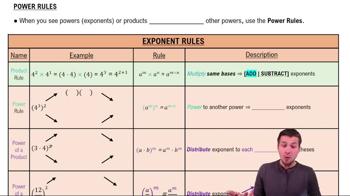
Power Rules

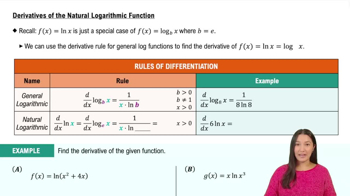
Natural Logarithm (ln)

The natural logarithm, denoted as ln(x), is the logarithm to the base e, where e is approximately 2.71828. It is a key function in calculus, particularly in limits and derivatives, due to its unique properties, such as ln(1) = 0 and its derivative being 1/x. Understanding the behavior of ln(x) as x approaches 0 is essential for evaluating limits involving this function.
Video consigliato:
05:18
Derivative of the Natural Logarithmic Function
Pratica correlata
Domanda del libro di testo

Increasing and decreasing functions. Find the intervals on which f is increasing and the intervals on which it is decreasing.


f(x) = xe⁻(ˣ²/₂)

199
views

Domanda del libro di testo

Avalanche forecasting Avalanche forecasters measure the temperature gradient dT/dh, which is the rate at which the temperature in a snowpack T changes with respect to its depth h. A large temperature gradient may lead to a weak layer in the snowpack. When these weak layers collapse, avalanches occur. Avalanche forecasters use the following rule of thumb: If dT/dh exceeds 10° C/m anywhere in the snowpack, conditions are favorable for weak-layer formation, and the risk of avalanche increases. Assume the temperature function is continuous and differentiable.


a. An avalanche forecaster digs a snow pit and takes two temperature measurements. At the surface (h = 0), the temperature is -16° C. At a depth of 1.1 m, the temperature is -2° C. Using the Mean Value Theorem, what can he conclude about the temperature gradient? Is the formation of a weak layer likely?

176
views
Domanda del libro di testo

Graphing functions Use the guidelines of this section to make a complete graph of f.


f(x) = 1/(e⁻ˣ - 1)

160
views
Domanda del libro di testo

Increasing and decreasing functions. Find the intervals on which f is increasing and the intervals on which it is decreasing.


f(x) = x⁴/4 - 8x³/3 + 15x²/2 + 8

270
views
Domanda del libro di testo

Use the following graphs to identify the points (if any) on the interval [a, b] at which the function has an absolute maximum or an absolute minimum value <IMAGE>

185
views
Domanda del libro di testo

17–83. Limits Evaluate the following limits. Use l’Hôpital’s Rule when it is convenient and applicable.


lim_x→2π (x sin x + x² - 4π²) / (x - 2π)

166
views