
Ch. 4 - Applications of the Derivative
Briggs - Calculus: Early Transcendentals 3rd Edition
Briggs3rd EditionCalculus: Early TranscendentalsISBN: 9780136847243Non è quello che usi tu?Cambia libro di testo
Capitolo 4, Problema 4.9.67

23–68. Indefinite integrals Determine the following indefinite integrals. Check your work by differentiation.


∫ (√x(2x⁶ - 4³√)dx

Guida verificata passo dopo passo
1
Rewrite the integral to simplify the expression. Break down the terms inside the integral: \( \int \sqrt{x}(2x^6 - 4\sqrt[3]{x}) \, dx \). Recall that \( \sqrt{x} = x^{1/2} \) and \( \sqrt[3]{x} = x^{1/3} \). Distribute \( x^{1/2} \) across the terms inside the parentheses.
After distributing, the integral becomes \( \int (2x^{6 + 1/2} - 4x^{1/2 + 1/3}) \, dx \). Simplify the exponents by adding the powers: \( 6 + 1/2 = 13/2 \) and \( 1/2 + 1/3 = 3/6 + 2/6 = 5/6 \). The integral is now \( \int (2x^{13/2} - 4x^{5/6}) \, dx \).
Apply the power rule for integration: \( \int x^n \, dx = \frac{x^{n+1}}{n+1} + C \), where \( n \neq -1 \). Integrate each term separately. For the first term, \( 2x^{13/2} \), the new exponent is \( 13/2 + 1 = 15/2 \), and the coefficient becomes \( \frac{2}{15/2} = \frac{4}{15} \). For the second term, \( -4x^{5/6} \), the new exponent is \( 5/6 + 1 = 11/6 \), and the coefficient becomes \( \frac{-4}{11/6} = \frac{-24}{11} \).
Combine the results of the integration. The indefinite integral becomes \( \frac{4}{15}x^{15/2} - \frac{24}{11}x^{11/6} + C \), where \( C \) is the constant of integration.
Check your work by differentiating the result. Differentiate \( \frac{4}{15}x^{15/2} - \frac{24}{11}x^{11/6} + C \) term by term using the power rule for differentiation: \( \frac{d}{dx}x^n = nx^{n-1} \). Verify that the derivative matches the original integrand \( \sqrt{x}(2x^6 - 4\sqrt[3]{x}) \).

Risposta video verificata per un problema simile:

Questa soluzione video è stata consigliata dai nostri tutor come utile per risolvere questo problema.
Durata del video:
3m

Concetti chiave

Ecco i concetti essenziali che devi comprendere per rispondere correttamente alla domanda.

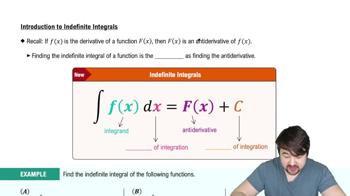
Indefinite Integrals

Indefinite integrals represent a family of functions whose derivative is the integrand. They are expressed with the integral sign and do not have specified limits, resulting in a general solution plus a constant of integration (C). Understanding how to compute indefinite integrals is crucial for solving problems in calculus, as they are foundational to the concept of antiderivatives.
Video consigliato:
Percorso guidato
05:04
Introduction to Indefinite Integrals

Integration Techniques

Various techniques are used to evaluate integrals, including substitution, integration by parts, and recognizing standard forms. For the given integral, recognizing the structure of the integrand, such as factoring or simplifying expressions, can facilitate the integration process. Mastery of these techniques is essential for effectively solving more complex integrals.
Video consigliato:
Percorso guidato
06:18
Integration by Parts for Definite Integrals

Verification by Differentiation

After finding an indefinite integral, it is important to verify the result by differentiating the antiderivative obtained. This process ensures that the derivative of the antiderivative returns to the original integrand. This verification step is a critical part of the integration process, confirming the accuracy of the solution and reinforcing the relationship between differentiation and integration.
Video consigliato:
Percorso guidato
05:53
Finding Differentials
Pratica correlata
Domanda del libro di testo

{Use of Tech} Finding roots with Newton’s method For the given function f and initial approximation x₀, use Newton’s method to approximate a root of f. Stop calculating approximations when two successive approximations agree to five digits to the right of the decimal point after rounding. Show your work by making a table similar to that in Example 1.


f(x) = cos⁻¹ x - x; x₀ = 0.75

268
views
Domanda del libro di testo

17–83. Limits Evaluate the following limits. Use l’Hôpital’s Rule when it is convenient and applicable.


lim_x→ ∞ (e³ˣ ) / (3e³ˣ + 5)

240
views
Domanda del libro di testo

Use the following graphs to identify the points (if any) on the interval [a, b] at which the function has an absolute maximum or an absolute minimum value <IMAGE>

183
views
Domanda del libro di testo

Sketching curves Sketch a graph of a function f that is continuous on (-∞,∞) and has the following properties.


f'(x) < 0 and f"(x) > 0 on (-∞,0); f'(x) > 0 and f"(x) < 0 on (0,∞)

240
views
Domanda del libro di testo

Acceleration to position Given the following acceleration functions of an object moving along a line, find the position function with the given initial velocity and position.


a(t) = 2 + 3 sin t; v(0) = 1, s(0) = 10

94
views
Domanda del libro di testo

Designer functions Sketch the graph of a function f that is continuous on (-∞,∞) and satisfies the following sets of conditions.


f"(x) > 0 on (-∞,-2); f"(-2) = 0; f'(1) = 0; f"(2) = 0; f'(3) = 0; f"(x) > 0 on (4,∞)

302
views