Ch. 4 - Applications of the Derivative
Briggs - Calculus: Early Transcendentals 3rd Edition
Briggs3rd EditionCalculus: Early TranscendentalsISBN: 9780136847243Non è quello che usi tu?Cambia libro di testo
Capitolo 4, Problema 4.R.73

60–81. Limits Evaluate the following limits. Use l’Hôpital’s Rule when needed. 
lim_x→∞ ln ((x +1) / (x-1))

Guida verificata passo dopo passo
1
Identify the form of the limit as x approaches infinity: lim_(x→∞) ln((x + 1) / (x - 1)). This is an indeterminate form of type ∞/∞.
Apply l'Hôpital's Rule, which is used to evaluate limits of indeterminate forms. First, differentiate the numerator and the denominator of the argument of the logarithm separately.
Differentiate the numerator (x + 1) to get 1, and the denominator (x - 1) to get 1. The limit now becomes lim_(x→∞) ln(1).
Since ln(1) is a constant, the limit simplifies to 0.
Conclude that the limit of the original expression as x approaches infinity is 0.

Risposta video verificata per un problema simile:

Questa soluzione video è stata consigliata dai nostri tutor come utile per risolvere questo problema.
Durata del video:
2m

Concetti chiave

Ecco i concetti essenziali che devi comprendere per rispondere correttamente alla domanda.

Limits

Limits are fundamental concepts in calculus that describe the behavior of a function as its input approaches a certain value. They help in understanding the function's behavior at points where it may not be explicitly defined, such as at infinity or discontinuities. Evaluating limits is crucial for determining the continuity and differentiability of functions.
Video consigliato:
05:50
One-Sided Limits

Natural Logarithm

The natural logarithm, denoted as ln(x), is the logarithm to the base e, where e is approximately 2.71828. It is a key function in calculus, particularly in growth and decay problems, and is often used in limits involving exponential functions. Understanding its properties, such as its domain and range, is essential for evaluating limits that involve logarithmic expressions.
Video consigliato:
05:18
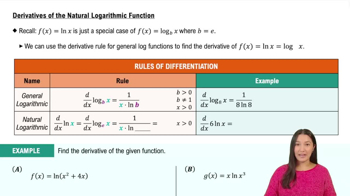
Derivative of the Natural Logarithmic Function

l'Hôpital's Rule

l'Hôpital's Rule is a method for evaluating limits that result in indeterminate forms, such as 0/0 or ∞/∞. It states that if the limit of f(x)/g(x) leads to an indeterminate form, the limit can be found by taking the derivative of the numerator and the derivative of the denominator separately. This rule simplifies the process of finding limits, especially when dealing with complex functions.
Video consigliato:
5:50
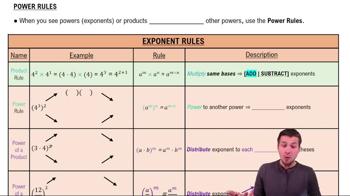
Power Rules
Pratica correlata
Domanda del libro di testo

Find the critical points of the following functions on the given intervals. Identify the absolute maximum and absolute minimum values (if they exist).

ƒ(x) = sin 2x + 3 on [-π , π]

211
views

Domanda del libro di testo

Find the critical points of the following functions on the given intervals. Identify the absolute maximum and absolute minimum values (if they exist).

ƒ(x) = x³ - 6x² on [-1, 5]

264
views
Domanda del libro di testo

82–89. Comparing growth rates Determine which of the two functions grows faster, or state that they have comparable growth rates.


2ˣ and 4ˣ⸍²

275
views
Domanda del libro di testo

24–34. Curve sketching Use the guidelines given in Section 4.4 to make a complete graph of the following functions on their domains or on the given interval. Use a graphing utility to check your work.


{Use of Tech} ƒ(x) = x (x -1)e⁻ˣ

267
views
Domanda del libro di testo

Maximum printable area A rectangular page in a text (with width x and length y) has an area of 98 in² , top and bottom margins set at 1 in, and left and right margins set at 1/2 in. The printable area of the page is the rectangle that lies within the margins. What are the dimensions of the page that maximize the printable area?

227
views
Domanda del libro di testo

24–34. Curve sketching Use the guidelines given in Section 4.4 to make a complete graph of the following functions on their domains or on the given interval. Use a graphing utility to check your work.

ƒ(x) = ln( x² + 3) / (x -1)

172
views