Ch. 4 - Applications of the Derivative
Briggs - Calculus: Early Transcendentals 3rd Edition
Briggs3rd EditionCalculus: Early TranscendentalsISBN: 9780136847243Non è quello che usi tu?Cambia libro di testo
Capitolo 4, Problema 4.R.84

82–89. Comparing growth rates Determine which of the two functions grows faster, or state that they have comparable growth rates.


ln x and log₁₀ x

Guida verificata passo dopo passo
1
Step 1: Understand the problem by identifying the two functions involved: ln(x) and log₁₀(x). These are logarithmic functions with different bases. ln(x) is the natural logarithm with base e, and log₁₀(x) is the common logarithm with base 10.
Step 2: Recall the change of base formula for logarithms, which allows us to express log₁₀(x) in terms of ln(x). The formula is: log₁₀(x) = ln(x) / ln(10). This will help us compare the growth rates of the two functions.
Step 3: Analyze the growth rates by considering the derivative of each function. The derivative of ln(x) with respect to x is 1/x, and the derivative of log₁₀(x) with respect to x is 1/(x ln(10)).
Step 4: Compare the derivatives: Since 1/x is greater than 1/(x ln(10)) for all x > 0, ln(x) grows faster than log₁₀(x) as x increases.
Step 5: Conclude that ln(x) grows faster than log₁₀(x) because the derivative of ln(x) is larger than the derivative of log₁₀(x) for all x > 0, indicating a faster rate of increase.

Risposta video verificata per un problema simile:

Questa soluzione video è stata consigliata dai nostri tutor come utile per risolvere questo problema.
Durata del video:
4m

Concetti chiave

Ecco i concetti essenziali che devi comprendere per rispondere correttamente alla domanda.

Growth Rates of Functions

The growth rate of a function describes how quickly its value increases as the input approaches infinity. In calculus, we often compare functions by analyzing their limits or using L'Hôpital's rule to determine which function grows faster. Understanding growth rates is essential for comparing functions like ln(x) and log₁₀(x).
Video consigliato:
Percorso guidato
04:16
Intro To Related Rates

Natural Logarithm vs. Common Logarithm

The natural logarithm, denoted as ln(x), is the logarithm to the base e (approximately 2.718), while log₁₀(x) is the logarithm to the base 10. These two logarithmic functions have different properties and growth rates, which can be analyzed using their derivatives or limits. Recognizing the differences between these logarithmic functions is crucial for the comparison.
Video consigliato:
05:18
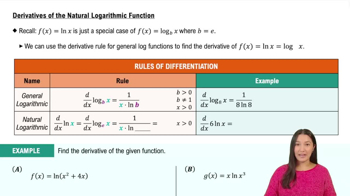
Derivative of the Natural Logarithmic Function

Limits and L'Hôpital's Rule

L'Hôpital's Rule is a method used to evaluate limits of indeterminate forms, such as 0/0 or ∞/∞. By taking the derivative of the numerator and denominator, we can simplify the limit and determine the growth rates of functions. This technique is particularly useful when comparing ln(x) and log₁₀(x) as x approaches infinity.
Video consigliato:
05:50
One-Sided Limits