Ch. 4 - Applications of the Derivative
Briggs - Calculus: Early Transcendentals 3rd Edition
Briggs3rd EditionCalculus: Early TranscendentalsISBN: 9780136847243Non è quello che usi tu?Cambia libro di testo
Capitolo 4, Problema 34

Demand and elasticity The economic advisor of a large tire store proposes the demand function D(p) = 1800/p-40, where D(p) is the number of tires of one brand and size that can be sold in one day at a price p.
c. Find the elasticity function on the domain of the demand function.

Guida verificata passo dopo passo
1
Step 1: Understand the demand function D(p) = \(\frac{1800}{p}\) - 40. This function represents the number of tires sold per day at a price p.
Step 2: Recall the formula for elasticity of demand, E(p), which is given by E(p) = \(\frac{p}{D(p)}\) \(\cdot\) \(\frac{dD}{dp}\). This measures how sensitive the quantity demanded is to a change in price.
Step 3: Differentiate the demand function D(p) with respect to p to find \(\frac{dD}{dp}\). For D(p) = \(\frac{1800}{p}\) - 40, use the power rule and the constant rule to find the derivative.
Step 4: Substitute D(p) and \(\frac{dD}{dp}\) into the elasticity formula E(p) = \(\frac{p}{D(p)}\) \(\cdot\) \(\frac{dD}{dp}\).
Step 5: Simplify the expression for E(p) to find the elasticity function. This will involve algebraic manipulation to express E(p) in terms of p.

Risposta video verificata per un problema simile:

Questa soluzione video è stata consigliata dai nostri tutor come utile per risolvere questo problema.
Durata del video:
3m

Concetti chiave

Ecco i concetti essenziali che devi comprendere per rispondere correttamente alla domanda.

Demand Function

A demand function expresses the relationship between the price of a good and the quantity demanded by consumers. In this case, D(p) = 1800/p - 40 indicates how the number of tires sold changes as the price p varies. Understanding this function is crucial for analyzing how price affects consumer behavior in the market.
Video consigliato:
Percorso guidato
06:21
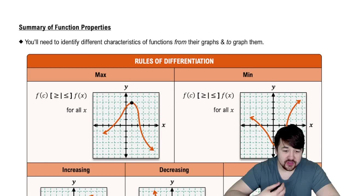
Properties of Functions

Elasticity of Demand

Elasticity of demand measures how responsive the quantity demanded is to a change in price. It is calculated as the percentage change in quantity demanded divided by the percentage change in price. This concept helps determine whether demand is elastic (sensitive to price changes) or inelastic (less sensitive), which is essential for pricing strategies.
Video consigliato:
04:18
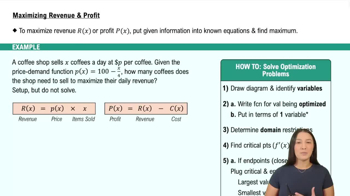
Maximizing Profit & Revenue

Calculating Elasticity

To find the elasticity function, we use the formula E(p) = (D'(p) * p) / D(p), where D'(p) is the derivative of the demand function with respect to price. This calculation provides a function that describes how elasticity varies with price, allowing for a deeper understanding of consumer sensitivity to price changes across different price levels.
Video consigliato:
Percorso guidato
04:46
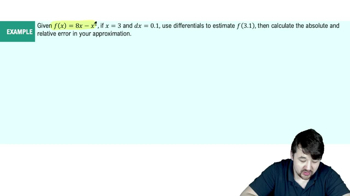
Determining Error and Relative Error Example 1