Ch. 4 - Applications of the Derivative
Briggs - Calculus: Early Transcendentals 3rd Edition
Briggs3rd EditionCalculus: Early TranscendentalsISBN: 9780136847243Non è quello che usi tu?Cambia libro di testo
Capitolo 4, Problema 4.6.70

Differentials Consider the following functions and express the relationship between a small change in x and the corresponding change in y in the form dy = f'(x)dx.


f(x) = ln (1 - x)

Guida verificata passo dopo passo
1
First, understand that the differential dy represents the change in the function y = f(x) when x changes by a small amount dx.
To find dy, we need to determine the derivative of the function f(x) = ln(1 - x). The derivative, f'(x), gives us the rate of change of y with respect to x.
Apply the chain rule to differentiate f(x) = ln(1 - x). The derivative of ln(u) with respect to u is 1/u, and the derivative of (1 - x) with respect to x is -1.
Combine these results to find f'(x): f'(x) = -1/(1 - x). This is the derivative of the function with respect to x.
Express the relationship between the small change in x (dx) and the corresponding change in y (dy) using the formula dy = f'(x)dx. Substitute f'(x) with the derivative found: dy = -1/(1 - x) * dx.

Risposta video verificata per un problema simile:

Questa soluzione video è stata consigliata dai nostri tutor come utile per risolvere questo problema.
Durata del video:
3m

Concetti chiave

Ecco i concetti essenziali che devi comprendere per rispondere correttamente alla domanda.

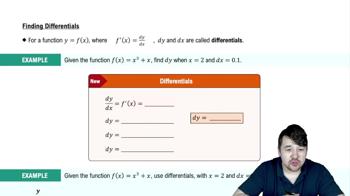
Differentials

Differentials represent the relationship between small changes in variables. In calculus, the differential of a function, denoted as dy, indicates how much the function's output changes in response to a small change in its input, dx. This concept is foundational for understanding how functions behave locally and is crucial for applications in optimization and approximation.
Video consigliato:
Percorso guidato
05:53
Finding Differentials

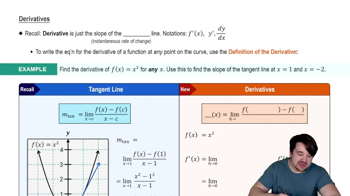
Derivative

The derivative of a function, denoted as f'(x), measures the rate at which the function's value changes as its input changes. It is defined as the limit of the average rate of change of the function over an interval as the interval approaches zero. In the context of differentials, the derivative provides the proportionality constant that relates the small changes in x and y, allowing us to express dy in terms of dx.
Video consigliato:

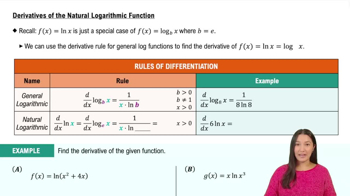
Natural Logarithm Function

The natural logarithm function, denoted as ln(x), is the logarithm to the base e, where e is approximately 2.71828. It is a fundamental function in calculus, particularly in integration and differentiation. The function f(x) = ln(1 - x) is defined for x < 1 and has specific properties, such as being concave down, which influences the behavior of its derivative and the corresponding differential.
Video consigliato:
05:18
Derivative of the Natural Logarithmic Function