Ch. 4 - Applications of the Derivative
Briggs - Calculus: Early Transcendentals 3rd Edition
Briggs3rd EditionCalculus: Early TranscendentalsISBN: 9780136847243Non è quello che usi tu?Cambia libro di testo
Capitolo 4, Problema 4.6.69

Differentials Consider the following functions and express the relationship between a small change in x and the corresponding change in y in the form dy = f'(x)dx.


f(x) = tan x

Guida verificata passo dopo passo
1
First, understand that the differential dy represents the change in the function's output, while dx represents a small change in the input x.
To find the relationship between dy and dx, we need to compute the derivative of the function f(x) = tan(x).
Recall that the derivative of tan(x) with respect to x is sec^2(x). This is a standard derivative result.
Express the differential relationship using the formula dy = f'(x)dx. Substitute f'(x) with sec^2(x) to get dy = sec^2(x)dx.
This equation, dy = sec^2(x)dx, shows how a small change in x (dx) affects the change in y (dy) for the function f(x) = tan(x).

Risposta video verificata per un problema simile:

Questa soluzione video è stata consigliata dai nostri tutor come utile per risolvere questo problema.
Durata del video:
2m

Concetti chiave

Ecco i concetti essenziali che devi comprendere per rispondere correttamente alla domanda.

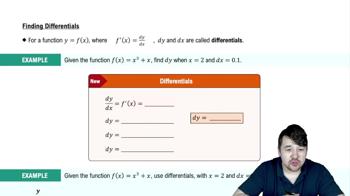
Differentials

Differentials represent the infinitesimal changes in variables. In calculus, if y = f(x), the differential dy is defined as dy = f'(x)dx, where f'(x) is the derivative of f with respect to x. This relationship allows us to approximate how a small change in x (denoted as dx) affects the change in y (denoted as dy).
Video consigliato:
Percorso guidato
05:53
Finding Differentials

Derivatives

The derivative of a function at a point measures the rate at which the function's value changes as its input changes. It is defined as the limit of the average rate of change of the function as the interval approaches zero. For the function f(x) = tan x, the derivative f'(x) can be calculated using differentiation rules, which will be essential for expressing dy in terms of dx.
Video consigliato:

Chain Rule

The chain rule is a fundamental theorem in calculus used to differentiate composite functions. It states that if a function y = f(g(x)) is composed of two functions, the derivative can be found by multiplying the derivative of the outer function by the derivative of the inner function. Understanding the chain rule is crucial when dealing with functions like f(x) = tan x, especially when applying it to find the relationship between dx and dy.
Video consigliato:
05:02
Intro to the Chain Rule