Ch. 4 - Applications of the Derivative
Briggs - Calculus: Early Transcendentals 3rd Edition
Briggs3rd EditionCalculus: Early TranscendentalsISBN: 9780136847243Non è quello che usi tu?Cambia libro di testo
Capitolo 4, Problema 4.9.15

Finding antiderivatives. Find all the antiderivatives of the following functions. Check your work by taking derivatives.


p(x) = 3 sec² x

Guida verificata passo dopo passo
1
Step 1: Recall the definition of an antiderivative. The antiderivative of a function is a function whose derivative is the original function. For this problem, we need to find the antiderivative of p(x) = 3 sec²(x).
Step 2: Identify the basic antiderivative rule that applies here. The derivative of tan(x) is sec²(x), so the antiderivative of sec²(x) is tan(x). Use this rule to find the antiderivative of 3 sec²(x).
Step 3: Multiply the constant 3 by the antiderivative of sec²(x). This gives us 3 tan(x) as part of the solution.
Step 4: Add the constant of integration, C, to account for all possible antiderivatives. The general antiderivative of p(x) = 3 sec²(x) is therefore 3 tan(x) + C.
Step 5: Verify your work by taking the derivative of the antiderivative you found. Differentiate 3 tan(x) + C, and confirm that the result is 3 sec²(x), which matches the original function.

Risposta video verificata per un problema simile:

Questa soluzione video è stata consigliata dai nostri tutor come utile per risolvere questo problema.
Durata del video:
3m

Concetti chiave

Ecco i concetti essenziali che devi comprendere per rispondere correttamente alla domanda.

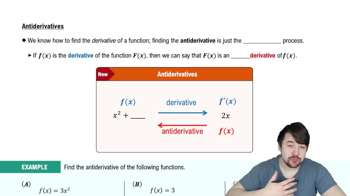
Antiderivatives

An antiderivative of a function is another function whose derivative is the original function. In calculus, finding antiderivatives is essential for solving problems related to integration. The process involves determining a function F(x) such that F'(x) equals the given function p(x). Antiderivatives are not unique; they can differ by a constant, represented as F(x) + C, where C is any constant.
Video consigliato:
Percorso guidato
05:50
Antiderivatives

Integration

Integration is the process of finding the integral of a function, which is closely related to finding antiderivatives. It can be thought of as the reverse operation of differentiation. The integral of a function over an interval gives the area under the curve of that function. In this context, the integral of p(x) = 3 sec² x will yield the family of functions that are antiderivatives of p(x).
Video consigliato:
Percorso guidato
06:18
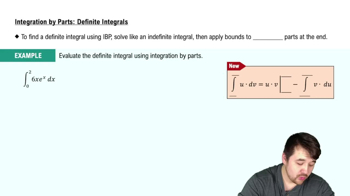
Integration by Parts for Definite Integrals

Derivative Check

To verify that a function is indeed an antiderivative, one can take its derivative and check if it matches the original function. This process is crucial in confirming the correctness of the antiderivative found. For example, if F(x) is an antiderivative of p(x), then differentiating F(x) should yield p(x). This step ensures that the integration process was performed correctly.
Video consigliato: