

Ch. 4 - Applications of the Derivative
Briggs - Calculus: Early Transcendentals 3rd Edition
Briggs3rd EditionCalculus: Early TranscendentalsISBN: 9780136847243Non è quello che usi tu?Cambia libro di testo
Capitolo 4, Problema 4.1.35

Locating critical points Find the critical points of the following functions. Assume a is a nonzero constant.


ƒ(x) = 1 / x + ln x

Guida verificata passo dopo passo
1
To find the critical points of the function \( f(x) = \frac{1}{x} + \ln x \), we first need to find its derivative \( f'(x) \).
Differentiate \( f(x) \) with respect to \( x \). The derivative of \( \frac{1}{x} \) is \( -\frac{1}{x^2} \) and the derivative of \( \ln x \) is \( \frac{1}{x} \). Therefore, \( f'(x) = -\frac{1}{x^2} + \frac{1}{x} \).
Set the derivative \( f'(x) \) equal to zero to find the critical points: \( -\frac{1}{x^2} + \frac{1}{x} = 0 \).
Solve the equation \( -\frac{1}{x^2} + \frac{1}{x} = 0 \) for \( x \). This involves finding a common denominator and simplifying the equation.
After solving the equation, determine the values of \( x \) that satisfy it. These values are the critical points of the function \( f(x) \).

Risposta video verificata per un problema simile:

Questa soluzione video è stata consigliata dai nostri tutor come utile per risolvere questo problema.
Durata del video:
3m

Concetti chiave

Ecco i concetti essenziali che devi comprendere per rispondere correttamente alla domanda.

Critical Points

Critical points of a function occur where its derivative is either zero or undefined. These points are essential for identifying local maxima, minima, and points of inflection. To find critical points, one must first compute the derivative of the function and then solve for the values of x that satisfy the condition of the derivative being zero or undefined.
Video consigliato:
04:50
Critical Points

Derivative

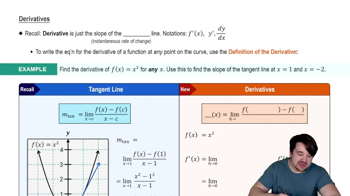
The derivative of a function measures the rate at which the function's value changes as its input changes. It is a fundamental concept in calculus that provides information about the function's slope at any given point. For the function ƒ(x) = 1/x + ln x, the derivative must be calculated to locate the critical points, which involves applying the rules of differentiation.
Video consigliato:

Natural Logarithm

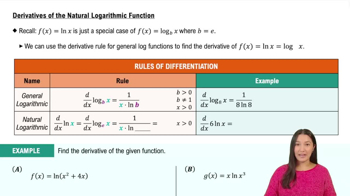
The natural logarithm, denoted as ln(x), is the logarithm to the base e, where e is approximately 2.71828. It is a key function in calculus, particularly in integration and differentiation. In the context of the given function, understanding the properties of the natural logarithm is crucial for correctly differentiating and analyzing the function's behavior near its critical points.
Video consigliato:
05:18
Derivative of the Natural Logarithmic Function
Pratica correlata
Domanda del libro di testo

{Use of Tech} Fixed points An important question about many functions concerns the existence and location of fixed points. A fixed point of f is a value of x that satisfies the equation f(x) = x; it corresponds to a point at which the graph of f intersects the line y = x. Find all the fixed points of the following functions. Use preliminary analysis and graphing to determine good initial approximations.


f(x) = tan x/2 on (-π,π)

179
views
Domanda del libro di testo

Finding antiderivatives. Find all the antiderivatives of the following functions. Check your work by taking derivatives.


ƒ(x) = eˣ

79
views
Domanda del libro di testo

17–83. Limits Evaluate the following limits. Use l’Hôpital’s Rule when it is convenient and applicable.


lim_x→ 0 (3 sin 4x) / 5x

204
views
Domanda del libro di testo

Use the following graphs to identify the points (if any) on the interval [a, b] at which the function has an absolute maximum or an absolute minimum value <IMAGE>

216
views
Domanda del libro di testo

Use linear approximations to estimate the following quantities. Choose a value of a to produce a small error.

1/³√510

335
views
Domanda del libro di testo

{Use of Tech} Fixed points An important question about many functions concerns the existence and location of fixed points. A fixed point of f is a value of x that satisfies the equation f(x) = x; it corresponds to a point at which the graph of f intersects the line y = x. Find all the fixed points of the following functions. Use preliminary analysis and graphing to determine good initial approximations.


f(x) = x³ - 3x² + x + 1

215
views