Ch. 4 - Applications of the Derivative
Briggs - Calculus: Early Transcendentals 3rd Edition
Briggs3rd EditionCalculus: Early TranscendentalsISBN: 9780136847243Non è quello che usi tu?Cambia libro di testo
Capitolo 4, Problema 4.5.11

Maximum-area rectangles Of all rectangles with a perimeter of 10, which one has the maximum area? (Give the dimensions.)

Guida verificata passo dopo passo
1
Start by understanding the relationship between the perimeter and the dimensions of a rectangle. The perimeter P of a rectangle with length l and width w is given by the formula: P=2(l+w). Since the perimeter is 10, we have: 2(l+w)=10.
Solve the perimeter equation for one of the variables, say w. From 2(l+w)=10, we get: l+w=5. Therefore, w=5-l.
Express the area A of the rectangle in terms of l. The area A is given by: A=l×w. Substitute the expression for w from the previous step: A=l×(5-l).
Simplify the expression for the area: A=5l-l2. This is a quadratic function in terms of l, which can be written as: A=-l2+5l.
Find the value of l that maximizes the area. Since the quadratic function A=-l2+5l is a downward-opening parabola, its maximum value occurs at the vertex. The vertex of a quadratic function ax+bx+c is given by -b/2a. Here, a=-1 and b=5, so calculate -5/(2×-1) to find the optimal length l.

Risposta video verificata per un problema simile:

Questa soluzione video è stata consigliata dai nostri tutor come utile per risolvere questo problema.
Durata del video:
4m

Concetti chiave

Ecco i concetti essenziali che devi comprendere per rispondere correttamente alla domanda.

Perimeter

Perimeter is the total distance around a two-dimensional shape. For rectangles, the perimeter (P) is calculated using the formula P = 2(length + width). In this problem, the perimeter is fixed at 10, which means the sum of the length and width must equal 5, allowing us to express one dimension in terms of the other.
Video consigliato:
13:49
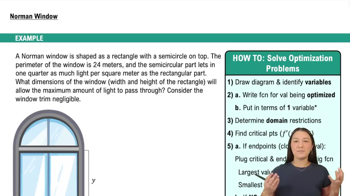
Example 4: Norman Window

Area of a Rectangle

The area of a rectangle is calculated by multiplying its length (l) by its width (w), expressed as A = l * w. To find the rectangle with the maximum area under a fixed perimeter, we need to express the area in terms of a single variable, which can be done by substituting the width with a function of the length derived from the perimeter constraint.
Video consigliato:
Percorso guidato
07:59
Estimating the Area Under a Curve Using Left Endpoints

Optimization

Optimization in calculus involves finding the maximum or minimum values of a function. In this context, we will use techniques such as taking the derivative of the area function and setting it to zero to find critical points. This will help us determine the dimensions of the rectangle that yield the maximum area while adhering to the given perimeter constraint.
Video consigliato:
10:13
Intro to Applied Optimization: Maximizing Area